

Incentive Travel in Japan: A Strategic Playbook from a Tokyo-Based Production Company
When the marketing director of a Singapore-headquartered retailer, the HR head of a Taiwanese supermarket chain, or the operations chief of a Hong Kong financial services group decides to design a reward program for their top performers, the conversation almost always turns to two questions. The first: where. The second: how do we make this trip feel like a reward, not a logistics exercise?
Japan has, over the past decade, become a default answer to the first question for a specific reason. The depth of experience available within a 5–7 day window is unmatched by other Asian destinations at equivalent travel cost. And the second question—the design question—is where most incentive programs to Japan succeed or fail. A generic Tokyo-Kyoto itinerary delivers a decent vacation. A purpose-designed itinerary delivers something the attendee remembers years later and tells colleagues about, which is what an incentive program is actually supposed to produce.
This guide is a playbook for the design question. It is built from programs we have produced for Asian and international clients, including a Japan-based reward program for PX Mart, Taiwan’s largest supermarket chain. For our complete portfolio of incentive programs, see Works: Incentive Trip.
For a more general framing of incentive travel strategy independent of destination, see our earlier guide Incentive Travel Strategies: How to Motivate Your Team(s) and Improve ROI. This article focuses specifically on the design choices that distinguish Japan-bound programs.
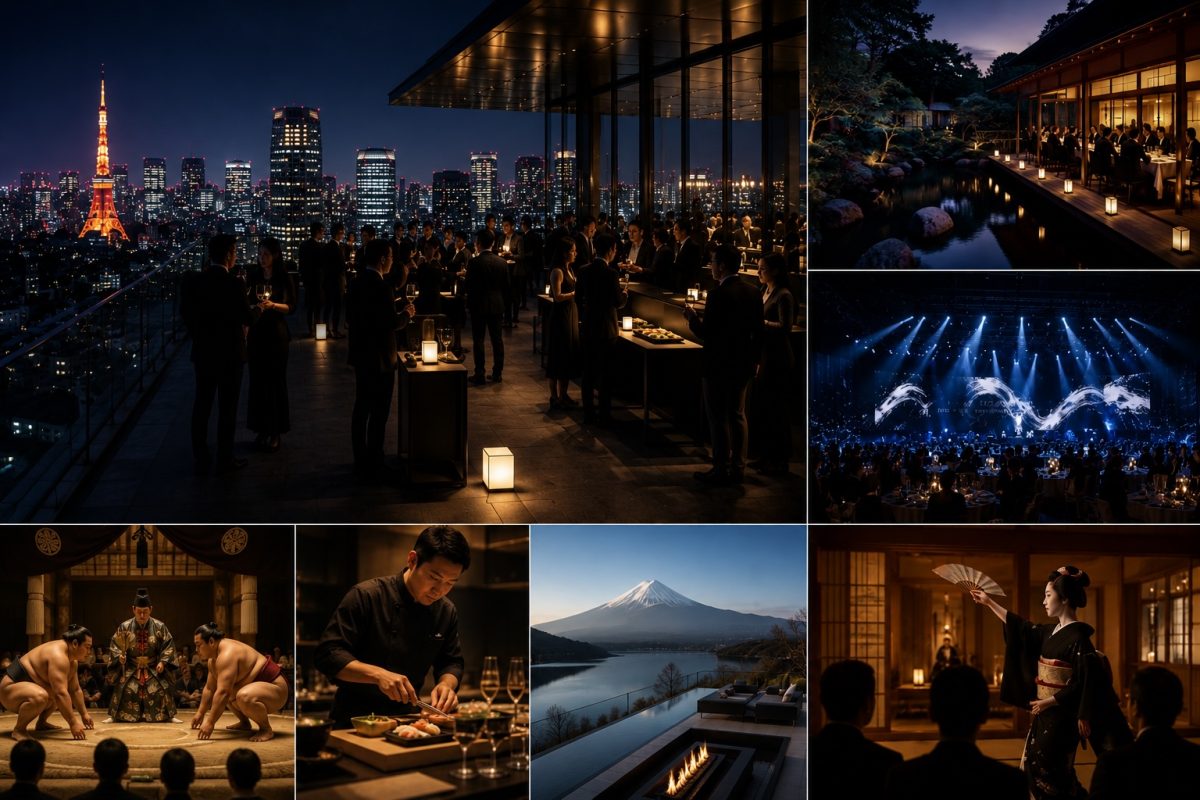
Why “Incentive Travel to Japan” Now
Three converging conditions have made 2024–2026 a strong window for Japan-bound incentive programs, particularly for source markets in Singapore, Taiwan, Hong Kong, Korea, and increasingly the United States and Europe.
Macro positioning. Currency dynamics through 2024–2026 have meaningfully improved the experience-per-dollar value of Japan-bound travel for clients invoicing in SGD, TWD, HKD, USD, EUR, and KRW. The same JPY budget delivers a noticeably more premium experience than it did pre-2022.
Inbound capacity expansion. Japan’s inbound visitor numbers reached new records in 2024–2025; JTB forecasts continue projecting strong volume into 2026. The infrastructure to support international groups—bilingual concierge services, luxury vehicle fleets, English-capable cultural-experience programming—has matured.
Strategic positioning. Among repeat visitors from Asia—particularly Taiwan and Singapore—there is increasing intention to visit regional Japan beyond the Tokyo-Kyoto-Osaka corridor. This opens up itinerary differentiation that simply wasn’t available when most groups stayed within the golden route. For organizations whose top performers have already been to Japan once or twice on personal travel, the corporate program must now deliver depth, not just access.
What Makes Japan Structurally Strong for Incentive Programs
Five structural features make Japan unusually well-suited to incentive programming compared to peer Asian destinations.
1. Combinable destinations within short transit windows. A 2-hour-15-minute shinkansen connects Tokyo to Kyoto. Osaka is 15 minutes further. Fukuoka is reachable by air in 90 minutes from Tokyo, or by shinkansen in 5 hours. Hokkaido is 90 minutes by air. This makes 5-night programs combining urban, traditional, and natural environments operationally easy in a way that few other Asian destinations match.
2. Four distinctive seasons. The same venue, restaurant, and outdoor location reads completely differently in March (cherry blossom), July (festivals), October (autumn foliage), and January (snow). A program that re-uses a destination across multi-year incentive cycles can feel materially different each year simply by changing the season.
3. The “Omotenashi” service register. Japanese hospitality operates at a level of attention that is structurally rare in global service industries. For incentive programs—where the attendee should feel cared for in ways they do not encounter in their regular work life—this register multiplies the perceived value of the reward.
4. Access to experiences that money alone cannot reliably book. Private temple dinners, master craftsperson demonstrations, kaiseki dining at restaurants with months-long waiting lists for individual guests, traditional inn (ryokan) takeovers for executive groups—these experiences exist in Japan and are structurally available only through partners with established relationships. Booking them is not a function of budget; it is a function of relationships.
5. Visual and culinary memorability. Japan photographs and tastes in ways that translate to social media, post-program internal communications, and the word-of-mouth recommendation that drives next year’s “I want to qualify for that trip” motivation among non-winners. The ROI of an incentive program compounds across years through the stories the attendees bring back; Japan’s stories travel particularly well.
Four Itinerary Archetypes That Actually Work
The single largest source of weak incentive programs to Japan is the generic Tokyo-Kyoto-Osaka loop. It is not wrong; it is simply under-designed for a reward context. The following four archetypes, drawn from programs we have actually produced, deliver materially stronger outcomes.
Archetype 1: The “Tokyo Urban-Premium” (4–5 nights)
Structure: Full program in central Tokyo with strategically chosen sub-areas. Day-by-day shifts across Marunouchi (heritage), Aoyama/Omotesando (design), Roppongi (international), Ginza (luxury retail), and Asakusa (traditional).
Best for: First-time Japan visitors; younger top-performer cohorts; tech-industry and creative-class teams.
Distinctive elements we have integrated: Private dinner at a heritage venue, behind-the-scenes Tsukiji/Toyosu morning experience, master sushi or kaiseki experience at a venue otherwise booked months ahead, evening at a designed cocktail venue with sommelier-led pairings.
Archetype 2: The “Tokyo + Kyoto Cultural Depth” (5–7 nights)
Structure: 2–3 nights Tokyo for the urban arrival, shinkansen transfer to Kyoto for 2–3 nights of cultural depth, optional Osaka conclusion. The most-requested archetype for European and North American incentive programs.
Best for: Programs where attendees have not been to Japan; programs with significant cultural-experience emphasis; luxury-tier programs where the venue is part of the reward.
Distinctive elements we have integrated: Private temple dinner, traditional tea ceremony with master practitioners, kaiseki dining at properties with months-long waiting lists, traditional craft master demonstration (lacquerware, ceramics, calligraphy), traditional inn (ryokan) stay with private onsen access.
Archetype 3: The “Tokyo + Regional Discovery” (5–6 nights)
Structure: 2 nights Tokyo as the gateway, 2–3 nights in a specific regional destination: Hokkaido (winter), Kanazawa (year-round craft and cuisine), Setouchi region (spring/autumn, art islands), Okinawa (year-round, beach-island reward narrative).
Best for: Repeat visitors who have already done Tokyo-Kyoto; programs designed for differentiation in a multi-year cycle; teams where geographic distinctiveness matters.
Distinctive elements we have integrated: Helicopter or chartered scenic flight, private gallery openings, signature regional cuisine experiences, master-craftsperson studio visits.
Archetype 4: The “Tokyo-Centric High Production” (3–5 nights)
Structure: Compact Tokyo-only program with high-production-value evening events anchored around a brand reception, awards dinner, or anniversary ceremony. This archetype works particularly well for programs where the incentive trip doubles as a brand-building moment for the organization.
Best for: Programs combined with an awards ceremony or company anniversary; programs requiring senior leadership presence with limited travel time; brand-led programs where attendee social media exposure is a measurable outcome.
Distinctive elements we have integrated: Custom-built stage production at a heritage venue, surprise reveal of next year’s reward destination, choreographed evening that combines award ceremony, dining, and entertainment under a single design.
The PX Mart program (case study below) is closest to this archetype.
Case Study: PX Mart — A Taiwanese Retailer’s Reward Program in Japan
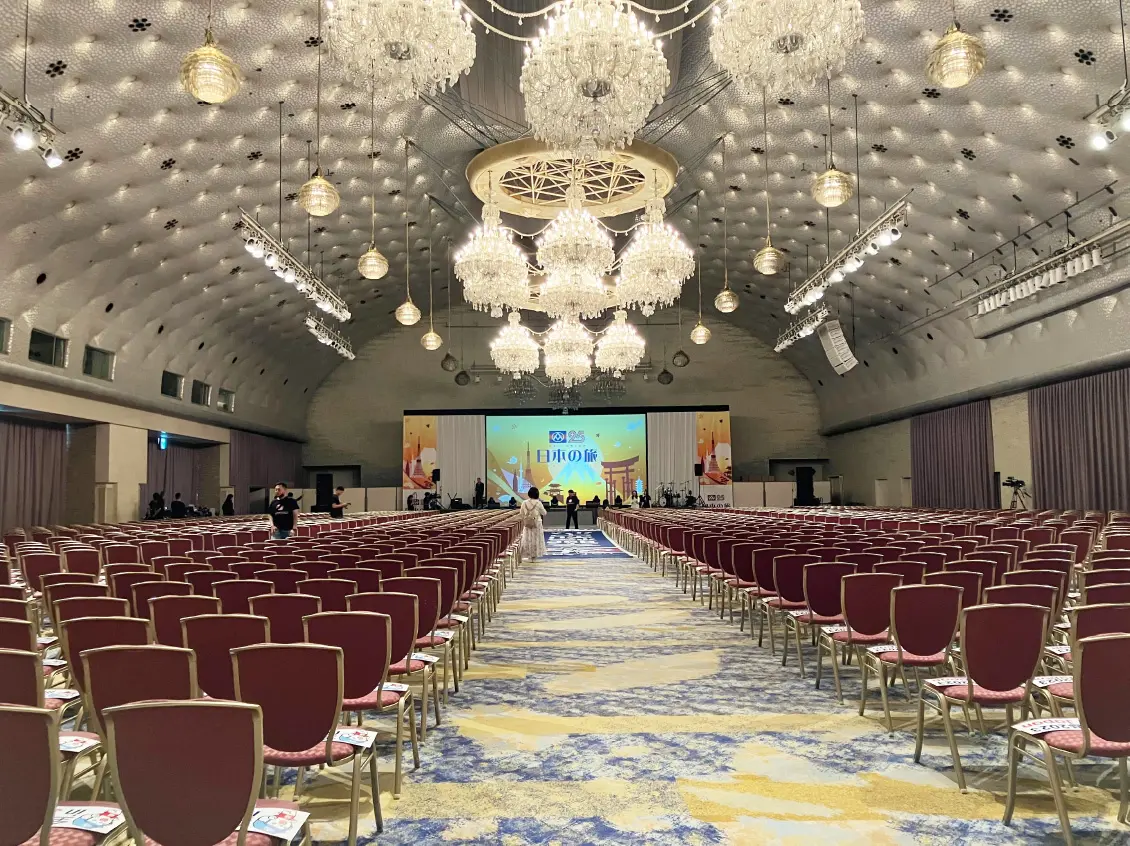
Client: PX Mart, Taiwan’s largest supermarket chain. Program: PX Mart 2023 in Japan — internal party for employees, October 17, 2023.
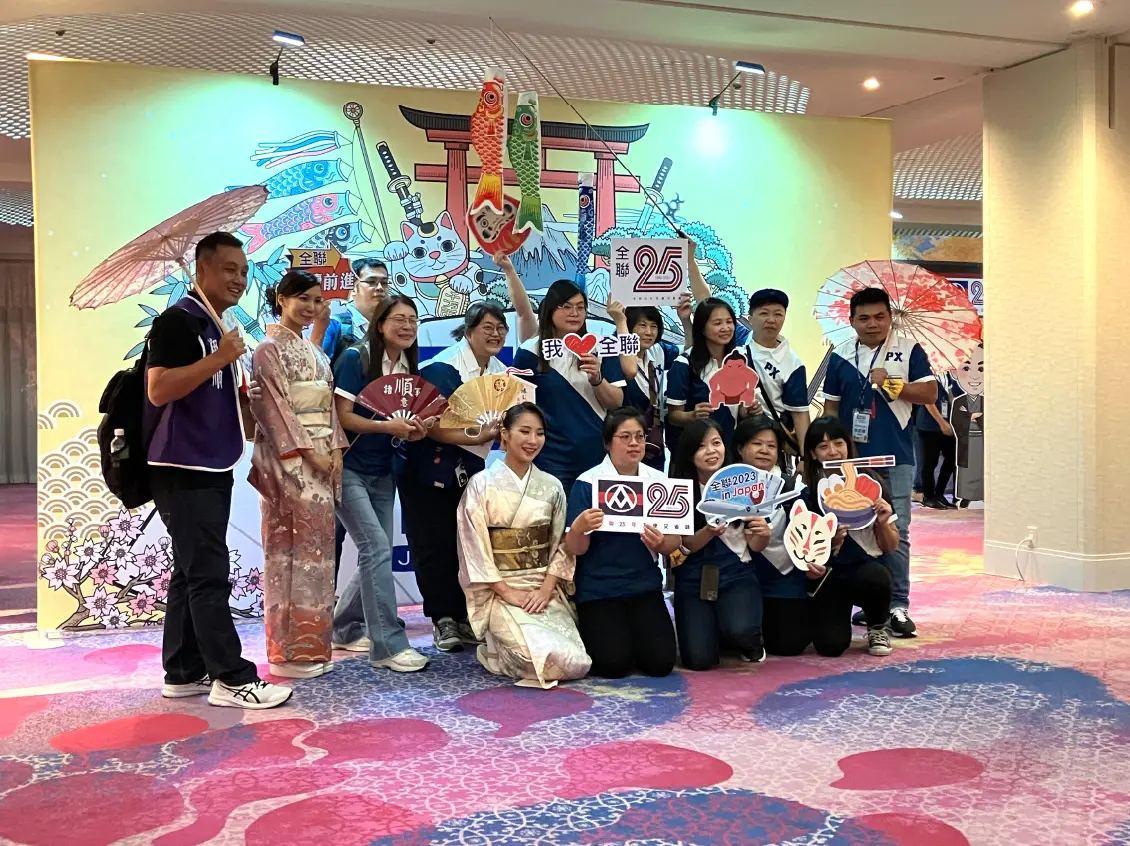
The brief was deceptively simple: produce a celebratory internal event in Japan for top-performing employees of a major Taiwanese retailer. The design challenge was to integrate Japanese-style spatial design with a program structure that delivered both reward energy and clear corporate motivation. The team-tags on the work portfolio—Japanese-style spatial design, motivation boost, reception—reflect the design priorities.
What distinguishes this program in the incentive-trip portfolio is the precision of Japanese-aesthetic integration into a corporate party format. The event was not a generic gala dinner in Tokyo; it was a deliberately designed Japanese-cultural experience built around the reward narrative.
For Taiwanese, Hong Kong, and Singaporean retailers and consumer-products organizations considering a Japan-bound reward program, this case study is the closest direct analog in our portfolio. Full case study: PX Mart 2023 in Japan
Designing the Program: A Four-Layer Framework
The most reliable design framework we use for incentive programs in Japan operates in four layers, designed top-down.
Layer 1: The reward narrative
What is this trip telling top performers about their relationship to the organization? The narrative is rarely “you earned a vacation.” Stronger narratives include: “you are the people who define our culture” (recognition); “we are investing in you because you will lead what is next” (development); “the experience you have on this trip will set the bar for what your contribution to next year looks like” (motivation).
The narrative shapes everything that follows. A “recognition” trip emphasizes ceremony and presentation. A “development” trip emphasizes shared discovery and collaboration. A “motivation” trip emphasizes exclusive and aspirational experiences.
Layer 2: The itinerary architecture
The four archetypes above. The architecture is selected to fit the reward narrative, the attendee profile, the season, and the budget envelope.
Layer 3: The signature experiences
Within the architecture, 3–5 signature experiences serve as the memory anchors of the trip. These are the experiences attendees will tell colleagues about for months afterward. Examples: a private temple dinner; a master-craftsperson demonstration with hands-on participation; a kaiseki dining experience at a top-tier venue; a private viewing or behind-the-scenes access to a landmark; a chartered scenic experience.
The signature experiences should be difficult—or nearly impossible—for individual travelers to arrange independently. This sense of exclusivity is essential to the program’s value as a reward.
Layer 4: The hospitality register
The signature experiences are the headlines; the hospitality register is the daily texture. This is where Japanese partner depth most visibly differentiates programs: meal selections with thoughtful balance across the days, transportation that anticipates rather than reacts, hotel and venue selections that align with the brand narrative, and concierge attention that handles attendee-specific needs without surfacing them.
For a deeper look at how we design venues into the experience itself, see our VENUE page. For the most distinctively Japanese cultural integration—particularly heritage venues, traditional craft experiences, and exclusive location access—our specialized inbound brand DRAGON EVENTS is purpose-built for this layer.
Realistic Budget Benchmarks
Indicative on-the-ground program costs per attendee, including production, venues, dining, ground transportation, and signature experiences, but excluding international airfare and accommodation:
- Compact Tokyo-only program, 3–4 nights: ¥250,000–¥600,000 per attendee (~US$1,650–US$4,000 / ~S$2,200–S$5,400)
- Tokyo + Kyoto cultural-depth program, 5–6 nights: ¥500,000–¥1,200,000 per attendee (~US$3,300–US$8,000 / ~S$4,500–S$10,800)
- Premium / heritage-led program with exclusive venue access: ¥1,000,000–¥2,500,000+ per attendee (~US$6,600–US$16,500+ / ~S$9,000–S$22,500+)
Group size affects per-attendee economics meaningfully. Programs below 20 attendees often carry higher per-attendee costs due to fixed production overheads; programs above 80 attendees benefit from economies of scale on transportation, group venues, and dedicated staffing.
International airfare and hotel accommodation are typically additional and are sourced separately—either through the client’s preferred travel partner or, for larger programs, through coordinated booking we manage as part of the production scope.
Currency conversions are approximate and based on exchange rates at the time of publication. Actual costs may vary depending on exchange-rate fluctuations.
Common Mistakes International Planners Make
1. Treating the trip as logistics rather than program design. A 5-day Japan trip booked through a generic travel agency delivers a vacation; an incentive program requires program design. The two cost approximately the same; the difference is entirely in the design.
2. Compressing the itinerary into the golden route by default. Tokyo-Kyoto-Osaka is well-trodden territory. For repeat-visit cohorts, more differentiated routing materially improves attendee experience.
3. Skipping the signature experiences to save budget. The signature experiences are the memory anchors. Cutting them to fund more general hospitality reduces the program’s ROI more than it reduces cost.
4. Underestimating the partner relationship value. A Japanese DMC or production partner with established venue and cultural-experience relationships materially expands what is possible. Without that depth, you are limited to what is publicly bookable.
5. Booking the season before locking the experience. Japan’s four-season calendar is one of its differentiators. Booking March because that is when the budget cycle aligns, without considering whether March or November better serves the experience design, is a frequent mismatch.
Frequently Asked Questions
Q: We are a Singapore-headquartered company. Should we partner with a Singapore travel agency or a Japan-based DMC?
A: For incentive programs intended as a genuine reward—not just a group trip—a Japan-based production partner usually delivers stronger outcomes. Singapore travel agencies have access to commercially available packages; Japan-based DMCs and production companies have access to venues, experiences, and relationships that are not commercially listed. The cost difference is typically not large; the experience difference can be substantial.
While GLOBAL PRODUCE is not a DMC, we can support destination management needs as part of a broader event or incentive program by collaborating with trusted travel and local partners. Please feel free to contact us to discuss the best structure for your program.
Q: How early do we need to start planning?
A: For premium-tier programs (heritage venues, traditional inns, peak-season dates), 9–12 months is the comfortable lead time. For mid-tier programs in shoulder seasons, 6 months is realistic. Some signature venues book 12–18 months ahead.
Q: How does Japan compare cost-wise with Hawaii, Bali, or Phuket as an incentive destination?
A: At equivalent quality tier, Japan is competitive in 2024–2026 currency conditions. The per-attendee cost in Japan is often lower than Hawaii (favorable yen positioning, no transpacific flight component for Asian source markets) and roughly comparable to premium Bali or Phuket programs once the quality tier is matched. Japan’s structural differentiation is on experience-per-dollar more than on absolute cost.
Q: Are family-included incentive trips common in Japan?
A: Yes, particularly for programs targeting senior-tier and long-tenure top performers. Japan is family-friendly in infrastructure, safety, and cultural-experience programming. The program design changes meaningfully when families are included—signature experiences need to be family-accessible, evening programming needs to balance adult reward content and family-inclusive content, and the architectural choices favor itineraries with fewer transitions.
Q: We are a smaller company (15–30 top performers). Is Japan feasible at our scale?
A: Yes—and the smaller scale often produces stronger experience design. Groups of 15–30 can access heritage venues, premium dining experiences, and concierge-level service that becomes operationally complex at 60+ attendees. Per-attendee budgets are typically higher for smaller groups, but the quality ceiling is also meaningfully higher.
Q: We did Hawaii two years ago and Bali last year. Why Japan next?
A: Three structural reasons. First, Japan offers experience depth (heritage, craft, cuisine, hospitality) that beach-destination incentives cannot match. Second, Japan’s four-season variability allows for multi-year repeat programs without feeling repetitive. Third, for top performers who have already done leisure-Japan personally, a corporate program with access to experiences and venues they could not book themselves operates at a different reward register.
Q: What about post-pandemic concerns?
A: Japan reopened to international travel in 2022 and inbound MICE volume has recovered strongly; capacity and experience access are at or above pre-pandemic levels by 2026. Health and safety protocols at premium venues remain robust without being intrusive to the attendee experience.
Conclusion
The strongest incentive programs we have produced in Japan share a single trait: the organization treated the program as a designed experience with a reward narrative, not as a logistics exercise with a destination. That framing changes every downstream decision—from itinerary architecture to venue selection to the signature experiences that become the memory anchors of the trip.
For Asian and overseas organizations considering Japan for an upcoming incentive cycle, our team would be glad to walk through your reward narrative and program objectives against the framework above. As a Tokyo-based event production company delivering more than 200 events annually—including incentive programs for clients across Asia and beyond—we maintain end-to-end production capability, bilingual project leadership, deep venue and cultural-experience relationships across Japan, and a track record of producing programs that attendees still talk about years later.
For programs requiring the most distinctively Japanese cultural integration—heritage venues, traditional craft, exclusive location access—our specialized inbound brand DRAGON EVENTS is built specifically for international planners.
[ See our complete Incentive Trip portfolio → ] [ Discover DRAGON EVENTS → ] [ Contact Us / Get a Quote → ]
SUPERVISED BY

A collective of event production professionals handling the planning, production, and management of over 200 events annually.
From internal gatherings like shareholders' meetings, anniversaries, and award ceremonies to external PR events and exhibitions, we design and deliver optimal communication solutions. Whether in-person, online, or hybrid, we give form to the messages companies wish to convey.