




What Is a Gala Dinner? Meaning, Dress Code & Hosting in Japan
A gala dinner is a formal, celebratory evening dinner held to mark a special occasion: a company anniversary, an awards night, a product launch, a charity fundraiser, or the last night of a conference or incentive trip. What makes it a gala rather than just a nice dinner is the combination of a reason to celebrate, a dress code, a program of speeches, awards, or entertainment, and a venue that feels like an occasion.
That’s the short answer. In practice, the phrase means slightly different things depending on where you hear it. In New York or London, it usually signals a black-tie fundraiser. On a resort booking in the Maldives or Thailand, it can be a mandatory line item on December 31. And for more and more corporate groups traveling to Japan, it’s the night the whole program builds toward.
I’ve written this guide for both kinds of readers. If you just want to know what a gala dinner is and what to wear, the first half has you covered. If you’re planning one for a group in Japan, the second half walks through venues, programs, and the decisions that actually make or break the night.
Key takeaways
- A gala dinner is a formal dinner held as a celebration. Oxford Learner’s Dictionaries defines a gala as “a special public celebration or entertainment” and uses “a gala dinner” as an example.
- Black tie is the most common gala dress code: a black dinner jacket (tuxedo) for men, and an evening dress, skirt, or evening trousers for women.
- Some resort hotels, with examples reported in the Maldives, Dubai, and Thailand, have charged a compulsory “gala dinner” on Christmas Eve or New Year’s Eve, on top of the room rate.
- In Japan, a gala dinner for international guests works best when it’s built around one strong Japanese moment, such as a kagami-biraki sake barrel opening, a taiko performance, or a sumo show.
- Pick the venue by seated dinner capacity, not headline capacity. In Japan, options range from Hotel Chinzanso Tokyo (up to 2,000 guests) to Osaka Geihinkan (102 seated, exclusive use).
- For heritage venues and peak-season dates, 9 to 12 months of lead time is comfortable.

Gala Dinner Meaning: What Makes a Dinner a “Gala”
A gala dinner is a dinner held as a celebration, with more formality and more of a program than an ordinary dinner.Oxford Learner’s Dictionaries defines a gala as “a special public celebration or entertainment,” with “a gala dinner/night” as an example of how the word is used. The word can be pronounced GAH-luh or GAY-luh; Oxford lists both.
In my experience, five things show up at almost every gala dinner:
- A reason to celebrate. An anniversary, an awards night, a launch, a fundraiser, or the closing night of a conference or incentive trip.
- Invited guests. Attendance is by invitation, and the guest list is part of the design.
- A dress code. Usually black tie or formal.
- A program. A welcome reception, speeches, awards, entertainment, and toasts, run to a timed schedule.
- A venue with presence. A hotel ballroom, a historic hall, a museum, or a garden.
Here’s how I usually put it to clients: if you could cut the program and nobody would notice, it was a dinner. If the program is the reason people remember the night, it was a gala.
Gala dinner vs. banquet, awards dinner, and reception
These terms overlap, and people use them loosely. Here’s how we use them when planning corporate events.
| Format | Main purpose | Typical dress code | What the program looks like |
| Gala dinner | Celebrate an occasion, honor people, or raise funds | Black tie or formal | Reception, speeches, awards or entertainment, toasts |
| Banquet | Serve a large formal meal to many guests | Business to formal | The meal is the center; speeches are optional |
| Awards dinner | Recognize winners or top performers | Business formal to black tie | The awards are the core of the night |
| Cocktail reception | Networking and mingling | Cocktail or business attire | Standing format, short remarks |
| Welcome dinner | Open a conference or incentive trip | Smart casual to business | Light program, a toast, and introductions |
Put simply, a gala dinner is a banquet with a reason and a program. An awards dinner becomes a gala when the celebration and the production matter as much as the awards themselves.
How “Gala Dinner” Is Used Around the World
The meaning stays the same everywhere, but the context changes a lot by region. That’s one reason so many people search for it: the same two words can describe a charity fundraiser, a state dinner, or a hotel’s holiday surcharge.
Charity and brand galas in the US and Europe
In the US and Europe, “gala” most often means an invitation-only evening for a cause or a brand, usually in black tie. For example, Dior and the nonprofit Venetian Heritage held a charity dinner at Teatro La Fenice in Venice on April 23, 2022, the opening day of the 59th Venice Biennale. Part of the funds went to Ukrainian refugees in Italy, according to FashionNetwork.
State and diplomatic gala dinners
Governments use gala dinners to welcome leaders at international summits. On November 17, 2022, Thailand’s Prime Minister Prayut Chan-o-cha hosted APEC leaders at a gala dinner in Bangkok, as reported by The Nation.
Japan has its own well-documented example. At the G20 Osaka Summit, the leaders’ dinner on June 28, 2019, was held at Osaka Geihinkan in the Nishinomaru Garden of Osaka Castle. According to Japan’s Ministry of Foreign Affairs, all dishes used Japanese ingredients, from Hokkaido in the first course to Okinawa in the fifth. Vegetarian, halal, and gluten-free dishes were prepared in separate cooking spaces, and the menu books were translated into 15 languages. That’s a useful benchmark for any gala with an international guest list.
Holiday gala dinners at resort hotels
If you came here because a hotel booking mentions a “compulsory gala dinner,” this is what it means. Some resort hotels have required every guest staying on Christmas Eve or New Year’s Eve to pay for a festive dinner, charged per person on top of the room rate. One Mile at a Time reported examples from hotels in the Maldives, Dubai, and Koh Samui, Thailand. Policies vary by hotel and by year, so check the booking terms for this supplement before you reserve holiday dates.
Corporate and MICE gala dinners
In MICE (meetings, incentives, conferences, and exhibitions), a gala dinner is usually the high point of the program: the closing night of a conference, the awards night of an incentive trip, or the main event of a company anniversary. It’s also a regular part of the brief for trips to Japan. In an August 2026 Trav Talk India article on Japan as a MICE destination, the chairman of the Network of Indian MICE Agents listed gala dinners among the requests incentive groups make.
Gala Dinner Dress Code: What to Wear
Unless the invitation says otherwise, it’s safest to assume black tie. It’s the most common gala dress code, and it’s easier to be slightly overdressed at a gala than underdressed.
| Dress code on the invitation | Men | Women |
| Black tie | A black dinner jacket (tuxedo), a white evening shirt, and a black bow tie | An evening dress or skirt; evening trousers are also acceptable |
| Black tie optional | A tuxedo is welcome; a dark suit and tie also work | An evening dress or an elegant cocktail dress |
| Cocktail or business formal | A dark suit and tie | A cocktail dress or a smart dress suit |
The black tie guidance follows the British etiquette publisher Debrett’s, which describes black tie as less formal than white tie and “the most popular formal evening wear.” The other two rows reflect common conventions; when in doubt, ask the host.
For international groups, I’d also suggest adding “or national dress” to the dress code. It lets guests wear formal attire from their own culture, whether that’s a sari, a sherwani, or a barong, and it tends to make the room more interesting, not less.
Two practical notes for galas in Japan:
- Announce the dress code in the first save-the-date, not the final invitation. International guests pack once. If they find out about black tie after they land, you’ve created a problem you can’t fix on-site.
- If guests will wear kimono, plan the dressing time into the schedule. Kimono dressing is a lovely experience, but it takes time and trained dressers. Treat it as a program item, not a side activity.
What Happens at a Gala Dinner? A Sample Program
In our experience, most corporate gala dinners run about three to four hours and follow a familiar arc: a reception, a welcome, dinner, one main moment, and a clear close. Here’s a sample program for a corporate gala dinner for around 200 guests in Japan. Every event is different, so treat the times as a starting point.
| Time | What happens |
| 18:30 | Guests arrive; welcome drinks in the foyer (30 to 45 minutes) |
| 19:15 | Doors open; guests take their seats; opening video and MC welcome |
| 19:25 | The host’s welcome speech (five minutes or less), then a kagami-biraki and a kanpai (toast) |
| 19:35 | Dinner service begins |
| 20:15 | The main moment: awards, or a performance such as taiko drumming or a sumo show |
| 21:00 | Dessert, closing remarks, and a group photo |
| 21:30 | Close; guests board coaches back to the hotel |
Kagami-biraki is a Japanese ceremony for opening a sake barrel. Guests of honor strike the barrel’s round wooden lid with wooden mallets, and the sake is then shared with everyone, often in square wooden masu cups. The name combines kagami, the sake industry’s word for the lid, and hiraku, “to open,” and the ceremony is associated with new beginnings, according to SAKETIMES. It’s one of the easiest ways to give an international gala a distinctly Japanese opening, and it gives your leadership a moment on stage that doesn’t involve a slide deck.
One thing I’ve learned: keep the speeches short and put them before the main course. Once dinner is in full swing, attention drops fast, and a ten-minute speech can flatten the energy you’ve spent the first hour building.
Why Host a Gala Dinner in Japan?
Japan gives a gala dinner things that are hard to replicate elsewhere: cuisine, culture, and venues that already feel like an occasion, plus the infrastructure to host large international groups. The demand side backs this up.
- International meetings: Japan hosted 491 international association meetings in 2025, up 15% from 2024. That put Japan sixth in the world and first in the Asia-Pacific for the fourth year in a row, according to ICCA statistics published by the Japan National Tourism Organization (JNTO).
- Visitors: Japan welcomed a record 42,683,600 international visitors in 2025, up 15.8% from 2024, according to JNTO as reported by Travel Voice.
- Incentive demand from Singapore: At the Japan Incentive Travel Roadshow 2026 in Singapore, buyers described Japan as a top choice for incentive trips, according to TTG MICE.
- Incentive demand from India: Indian MICE groups to Japan typically have 100 to 200 delegates and stay about five nights, according to JNTO’s New Delhi office as quoted by Trav Talk India.
The trade-offs are real, and it’s better to plan around them early:
- Inventory is tight. Strong demand means hotel rooms are hard to secure and preferential rates are hard to get, so planners advise booking well in advance (TTG MICE).
- Costs are higher than some regional alternatives. A Singapore planner quoted by TTG MICE noted that hotel and food costs in Japan are higher than in China and South Korea.
- Heritage venues are smaller and have rules. Many of Japan’s most memorable venues hold dozens or a few hundred guests, not a thousand, and they have rules on timing, catering, and what you can bring in.
- English support thins out outside major cities. TTG MICE also reported that planners often use suppliers from Tokyo or Osaka when working in smaller cities.
None of these are reasons to avoid Japan. They’re reasons to lock your headcount and venue early, and to work with a team that handles these details every week.
Gala Dinner Venues in Japan by Group Size
Start with your seated dinner headcount, then choose the venue type: hotel ballrooms for 500 or more guests, banquet halls and historic venues for about 100 to 300, and exclusive-use heritage venues for VIP groups of around 100. The capacities below come from our venue database, and they vary by layout.
| Venue | City | Capacity (as listed) | Why it works for a gala dinner |
| Hotel Chinzanso Tokyo | Tokyo | Up to 2,000 (Grand Hall Tsubaki, 1,350 m²) | A large ballroom with a stage and AV, overlooking a seasonal Japanese garden |
| Hotel Gajoen Tokyo | Tokyo | Up to 1,000 (Maiogi, 838 m²) | A “museum hotel” with Japanese art and crafts throughout the building |
| Cerulean Tower Tokyu Hotel + Cerulean Tower Noh Theatre | Tokyo | Up to 700 banquet-style (hotel); 201 seats (Noh theater) | A Noh or Kyogen performance in the theater, then dinner in the same building |
| Heian Jingu Kaikan | Kyoto | 200 cocktail / 180 seated (Seihou-den) | One of the largest banquet halls in Kyoto, next to the Shinen garden of Heian Shrine, with a 30-meter window onto the garden |
| Kotowa Kyoto Nakamurarou | Kyoto | 130 cocktail / 96 seated | A banquet venue inside the grounds of Yasaka Shrine in Gion, with gold folding screens and a garden view |
| Osaka Geihinkan | Osaka | 120 standing / 102 seated; exclusive use | The venue of the G20 Osaka Summit leaders’ dinner, with views of Osaka Castle |
| Sumo Live Restaurant Hirakuza Ginza Tokyo | Tokyo | About 150 | A life-size sumo ring at the center, with seating on 270 degrees around it |
| Yakatabune HARUMIYA | Tokyo Bay | 136 (per the venue specifications) | A chartered houseboat serving kaiseki cuisine, with sunken horigotatsuseating |
Capacities are from GLOBAL PRODUCE venue pages (checked October 29, 2026). The Cerulean Tower Tokyu Hotel figure is from our Corporate Event Venues in Tokyo 2026 guide. A seated dinner with a stage holds fewer guests than a standing reception, so confirm the final layout with each venue.
A few things I’d think about when choosing:
- The number that matters is seated dinner with a stage. Headline capacities often describe a standing reception or an empty room. Once you add a stage, an awards walkway, and a camera position, a room can lose a meaningful share of its seats.
- Tokyo is the default for large groups. It has the ballrooms, hotel inventory, and flight connections to host several hundred guests or more.
- Kyoto is beautiful, but heritage venue capacity is limited. For a leadership group of 40 to 150, Kyoto is a different story, and I’d often recommend it.
- A two-venue evening can work well. A cultural performance in one space and dinner in another, like the Noh theater and the hotel ballroom at Cerulean Tower, gives the night a clear first and second act.
You can browse more options in our venue database and in Japan Events: The Ultimate Guide, which covers event destinations beyond Tokyo.
Have a headcount and a rough date? Send them over, and we’ll check which venues can actually seat your group for dinner with a stage. Ask about venues
How to Plan a Gala Dinner in Japan: 7 Steps
Lock the purpose and the seated headcount first. The venue, program, and menu all follow from those two decisions.
- Define the one thing guests should remember. Is the night about honoring top performers, thanking partners, or marking an anniversary? Write it in one sentence. Every later decision gets easier.
- Fix the headcount and dates, and watch the season. Spring cherry blossom season and autumn foliage season are among the busiest times for hotels and venues. For premium-tier programs (heritage venues, traditional inns, peak-season dates), 9 to 12 months is a comfortable lead time, and some signature venues need 12 to 18 months, as we explain in Incentive Travel in Japan.
- Shortlist venues and read the house rules. Ask about end times, outside catering, open flames, sound levels, and load-in windows early. In Japan, every venue has its own rules, and heritage sites often have the strictest ones.
- Build the program around one Japanese moment. A single strong cultural highlight lands better than five short acts. Taiko, Noh, iaido, ikebana, a tea ceremony, or a sumo show can each carry the night if it’s staged well.
- Collect dietary requirements at registration. Ask about vegetarian, Jain, halal, gluten-free, and allergy needs before you choose the menu, not after. The G20 Osaka dinner, with separate cooking spaces and translated menus, is a good model.
- Plan the logistics around the guests. That includes coaches to and from the hotel, an English-speaking MC or interpreters, a rain plan for any garden or outdoor element, and photography rules at shrines and temples.
- Rehearse with the venue and crew. Walk the run-of-show on-site, including stage cues, award handovers, and the timing of the toast. In heritage venues, rehearsal time can be limited, so schedule it when you book.
What Drives the Cost of a Gala Dinner in Japan?
The cost of a gala dinner depends mostly on five things: the venue, food and drink per guest, production, entertainment, and guest transport. There’s no meaningful “average price,” because a 100-guest dinner at a heritage venue and a 1,000-guest ballroom gala are different projects. These are the line items to ask about when you compare quotes.
| Cost item | What it usually covers | What to check in Japan |
| Venue | A rental fee or a food-and-beverage minimum | Setup and teardown hours, extra facility fees, and the end time |
| Food and drink | The course menu and a drinks package, priced per guest | Separate menus for vegetarian, Jain, halal, gluten-free, and allergy needs |
| Production | Stage, lighting, sound, screens, and decor | Whether the venue has in-house equipment or everything must be brought in |
| Entertainment | Performers’ fees, rehearsals, and travel | Stage size, sound limits, and rehearsal time at the venue |
| Transport | Coaches between the hotel and the venue | Evening traffic, parking for coaches, and the return schedule |
| Language support | An English-speaking MC, interpreters, and translated menus and signage | Whether speeches need simultaneous or consecutive interpretation |
Here’s where I see budgets slip most often: production at heritage venues. The setting is stunning, but many historic buildings weren’t designed for lighting rigs or a large sound system, so more of the equipment has to be brought in and set up within a tight window. Ask about this before you fall in love with a venue.
If you’re budgeting a full incentive program rather than a single night, our Incentive Travel in Japan guide includes per-attendee budget benchmarks (excluding airfare and accommodation).
Common Gala Dinner Mistakes to Avoid
Most gala dinners that fall flat do so for predictable reasons, and nearly all of them can be fixed during planning.
- Assuming everyone knows what “gala” means. In some markets, including Japan, the format is less familiar. Explain the purpose and the dress code clearly in the invitation.
- Booking on headline capacity. Check the seated dinner capacity with your stage and production in place.
- Programming too many acts. One strong performance beats a parade of short ones.
- Letting speeches run long. Agree on time limits with speakers in advance.
- Cutting costs where guests can see it. Expectations at a gala are high, and guests notice a thin menu or a bare stage more than they notice a modest invitation.
- Forgetting the end of the night. Many venues have firm end times. Plan the last 30 minutes and the ride home as carefully as the opening.
How GLOBAL PRODUCE Produces Gala Dinners in Japan
GLOBAL PRODUCE is a Tokyo-based event production company that plans and runs corporate events in Japan from concept to the night itself, delivering more than 200 events a year. For international clients, we work under our DRAGON EVENTS brand, which combines Japanese culture, historic venues, and modern production.
- English-speaking producers and interpreters can handle every step in English, for groups from 20 to 30 guests up to more than 1,000.
- Japanese performing arts partners include Asakusa Kaguwa (dance), Aska-gumi (taiko drumming), Hogyokukai (iaido), Zetta (sumo show), the Ichiyo School of Ikebana, and Senchado (tea).
- A venue database of 100+ venues across Japan and overseas, from hotel ballrooms to heritage sites.
- Stage design ranges from Zen-inspired minimal sets to vibrant, Kabuki-style productions.
A few examples from our work:
- PX Mart 2023 in Japan: An internal party in Japan on October 17, 2023, for top-performing employees of PX Mart, Taiwan’s largest supermarket chain. It was designed as a Japanese-style experience built around the reward story, not as a generic gala dinner.
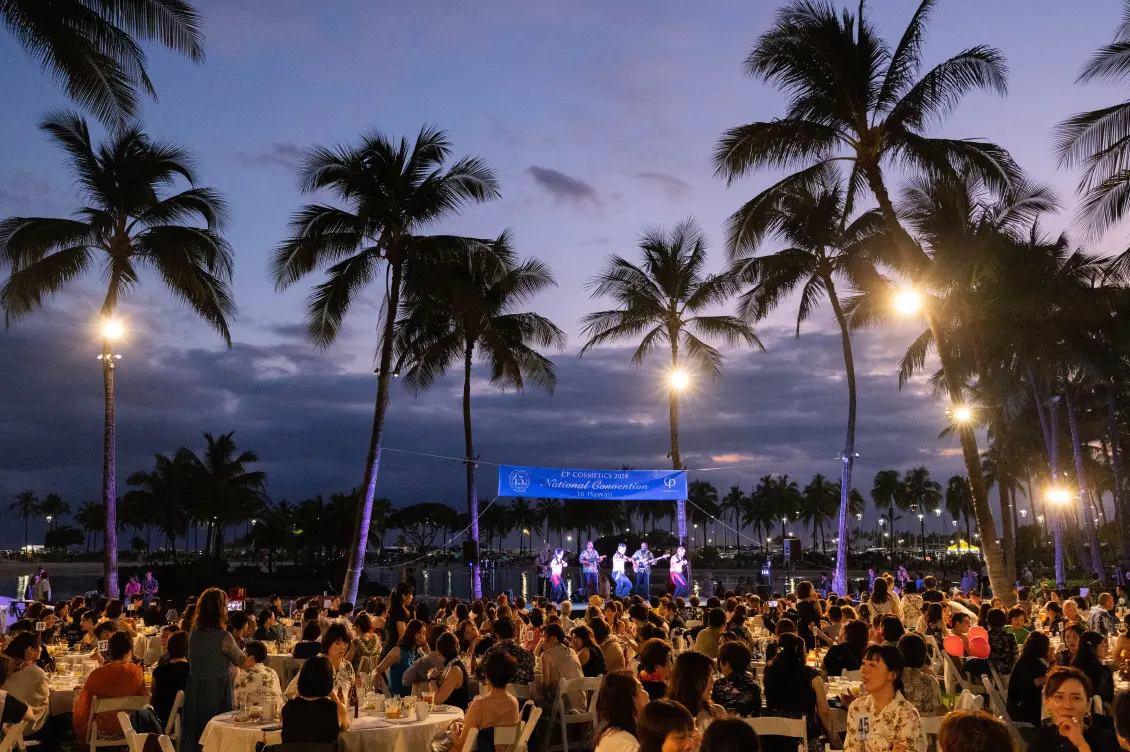
- CP Cosmetics, 45th anniversary incentive trip: An awards ceremony and party in Hawaii in June 2024. We used sound, lighting, and a finale to bring the spirit of Hawaii into the venue. The client told us, “The participants unanimously said that it was a great experience.”
- GP 15th Party “Momentum”: Our own 15th-anniversary evening on October 9, 2026, for about 400 invited guests across three floors of TRUNK(HOTEL) CAT STREET in Shibuya, with 15 LED screens and a red-carpet main stage.
Planning a gala dinner in Japan?
If you’re at the stage of choosing a date, a city, or a venue, I’m happy to talk it through. Share your headcount, dates, and what you want guests to remember, and we’ll come back with venue options and a program outline.
Not ready to talk yet? Download our company introduction and service overview to share with your team.
Gala Dinner FAQ
What does “gala dinner” mean?
A gala dinner is a formal, celebratory dinner held to mark a special occasion, such as an anniversary, an awards night, a fundraiser, or the closing night of a conference. It usually has a dress code, a program of speeches or entertainment, and an invited guest list.
What is the difference between a gala dinner and a banquet?
A banquet is any large formal meal for many guests. A gala dinner is a banquet with a celebratory purpose and a produced program, such as awards, performances, and toasts. Put simply, a gala dinner is a banquet with a reason and a program.
What should I wear to a gala dinner?
Unless the invitation says otherwise, wear black tie: a black dinner jacket (tuxedo) with a bow tie for men, and an evening dress, skirt, or evening trousers for women. If the invitation says “black tie optional,” a dark suit and tie is also fine.
Why does my hotel charge a compulsory gala dinner on Christmas Eve or New Year’s Eve?
Some resort hotels, including examples reported in the Maldives, Dubai, and Thailand, have required all guests staying on December 24 or 31 to pay for a festive gala dinner, charged per person on top of the room rate. Policies vary by hotel and year, so check the booking terms before you reserve holiday dates.
How long does a gala dinner last?
In our experience, most corporate gala dinners last about three to four hours, including a 30- to 45-minute welcome reception, dinner, the main program, and closing remarks. Heritage venues in Japan often have firm end times, so confirm the schedule with the venue.
Can you host a gala dinner at a temple, shrine, or historic site in Japan?
Yes. A number of shrines, gardens, and historic buildings in Japan accept private events. Examples include Heian Jingu Kaikan in Kyoto (180 seated) and Osaka Geihinkan (102 seated). Capacity is usually smaller than a hotel ballroom, and these venues have rules on timing, catering, and what you can bring in.
How far in advance should I book a gala dinner venue in Japan?
For heritage venues, traditional inns, and peak-season dates, 9 to 12 months is a comfortable lead time, and some signature venues need 12 to 18 months. Hotel rooms in Japan are also in high demand, so book the venue and the accommodation together.
How much does a gala dinner in Japan cost?
There’s no single price. The cost depends mainly on the venue (rental fee or food-and-beverage minimum), food and drink per guest, production (stage, lighting, sound, and screens), entertainment, and transport. Share your headcount, dates, and preferred venue type with a local production company to get a realistic quote.
How many guests can a gala dinner in Japan accommodate?
It depends on the venue. Large Tokyo hotel ballrooms can host anywhere from several hundred to more than 2,000 guests; for example, Hotel Chinzanso Tokyo’s Grand Hall Tsubaki holds up to 2,000. Historic and cultural venues typically hold about 100 to 300 guests.
Final Thoughts
A gala dinner is, at its core, a dinner with a reason and a program. That definition travels well. What changes from place to place is how much the setting can add to the night.
Japan can add a lot: the food, the venues, and cultural moments that guests remember for years. The trade-off is that the best options are limited and book early. So decide what the night is for, fix the seated headcount, and start the venue conversation sooner than feels necessary.
If you’re thinking about a gala dinner as part of a conference, incentive trip, or anniversary in Japan, feel free to reach out. We do a lot of these, and I’m happy to share what tends to work.
Related articles
- Incentive Travel in Japan: A Strategic Playbook from a Tokyo-Based Production Company
- Corporate Event Venues in Tokyo 2026: A Local Production Guide
- Business Events in Japan: The Complete Guide to Hosting
- Planning an Event in Japan?
- English Speaking Event Planner Tokyo
Sources
- Oxford Learner’s Dictionaries, “gala”
- Debrett’s, “Know Your Dress Codes”
- FashionNetwork, “Dior becomes key donor for Venice Biennale 2022, plans opening charity dinner” (April 19, 2022)
- The Nation, “World leaders arrive for APEC dinner” (November 17, 2022)
- Ministry of Foreign Affairs of Japan, “G20 Osaka Summit: Leaders’ Dinner”
- One Mile at a Time, “Mandatory Holiday Dinners: Have Hotels Lost Their Fool Minds?!?” (December 5, 2017)
- Trav Talk India, “Japan emerges as India’s next premium MICE playground” (August 4, 2026)
- SAKETIMES, “Sake 101: Kagami Biraki”
- JNTO, ICCA 2025 statistics release (May 20, 2026)
- Travel Voice, “International arrivals in Japan exceeded 42 million in 2025” (January 26, 2026)
- TTG MICE, “Japan remains top choice for Singapore incentives, but operational hurdles test planners” (August 19, 2026)
- GLOBAL PRODUCE venue pages, DRAGON EVENTS, and WORKS

SUPERVISED BY

A collective of event production professionals handling the planning, production, and management of over 200 events annually.
From internal gatherings like shareholders' meetings, anniversaries, and award ceremonies to external PR events and exhibitions, we design and deliver optimal communication solutions. Whether in-person, online, or hybrid, we give form to the messages companies wish to convey.


