

User Conference in Japan: Planning Guide
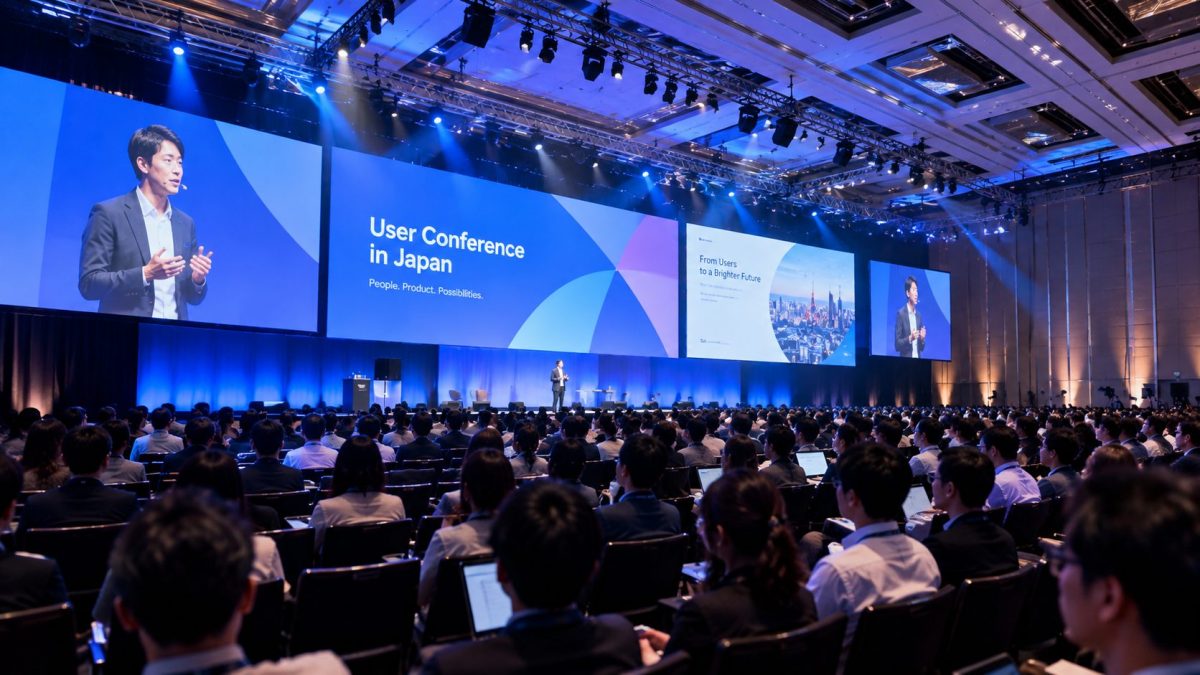
A user conference in Japan brings a company’s customers and product users together to learn, exchange practical experience and connect with specialists and peers. A useful program gives customers something they can apply after the event—not simply another presentation about the company.
For teams planning from Singapore or elsewhere in Asia-Pacific (APAC), the challenge is connecting regional priorities with the needs of customers in Japan. That requires a relevant agenda, approved customer stories, appropriate language support and a production plan that makes learning and conversation easy.
This guide is for customer marketing, customer success and event teams organizing a conference, rather than attendees looking for an event calendar.
Key planning decisions:
- Define what customers should be able to do or discuss after attending.
- Build the agenda with Japan-based customer teams and prospective participants.
- Approve customer content and recording permissions before production deadlines.
- Test breakout rooms, interpretation and demo capacity against the actual program.
- Assign owners for the event experience and the customer follow-up that comes next.
What makes a user conference different?
A user conference starts with customer learning and relationships. Prospects and partners can attend, but the program should still reward existing users for their time.
Names vary between organizations. Use the audience and the intended outcome to decide what to prioritize:
| Format | Core audience | Main planning emphasis |
| User or customer conference | Product users, customer decision-makers and invited prospects | Practical application, customer stories and peer exchange |
| Developer conference | Developers, architects and technical communities, who may also be customers | Building, integrating and testing technology |
| Sales kickoff | Sales teams and, in some programs, channel partners | Sales alignment, enablement and motivation |
A user conference can include technical sessions. The distinction is not “technical versus non-technical”: it is whether the overall program centers on customer use and relationships or on developing with the technology. This guide focuses on the former; specialist coding labs need their own technical production plan.
For an internal sales audience, see our Sales Kickoff in Japan guide.
Define the customer outcome before the agenda
Choose a primary customer outcome, then design sessions that help deliver it. Trying to maximize product education, executive engagement, new-business acquisition and community building equally can produce an unfocused day.
Start by asking the Japan customer team which questions recur and what would justify attending in person. Validate the proposed topics with customers where possible.
- Product users may want to improve a workflow, solve a recurring problem or compare approaches with peers.
- Business sponsors may want implementation lessons, organizational implications and a discussion with product leaders.
- Partners and prospects may need introductory context or evidence of practical use.
Give these groups a shared opening and different routes where their needs diverge. An advanced user should not have to sit through basic sales material to reach the session they came for.
Also distinguish a Japan-market conference from an APAC gathering hosted in Japan. Customer location, language preferences and travel constraints should determine the program; nationality alone is not a useful substitute for asking participants.
Build the Japan program around customer stories
Local customer examples make a regional message easier to evaluate. Ask speakers to explain the challenge, the approach, what was difficult and what another user could apply—not just present a polished success claim.
Two official programs illustrate this approach. dSPACE’s published program for its September 17, 2026 Japan User Conference combined practical use cases, demonstrations and a reception. CRScube’s announcement for its July 7, 2026 Tokyo conference described user-led case studies, feature demonstrations and networking. These are external program references, not GP projects or verified reports of event outcomes. dSPACE program / CRScube announcement.
Agree customer-speaker approvals in both languages
Set a named approval owner and a deadline for each customer presentation. A speaker agreeing to attend is not the same as their company approving slides, performance figures or public distribution.
Use this proposed approval sequence:
- Agree the audience, session purpose and whether the discussion is public or closed-room.
- Confirm approved company names, logos, screenshots and claims with the customer.
- Review the Japanese presentation and any English translation against the same approved content.
- Record permissions separately for live delivery, livestreaming, on-demand video and quotations.
- Freeze the approved version, then brief the moderator, interpreter and production team from it.
If approval is late, prepare an alternative session rather than publishing unapproved material. This is a practical workflow for cross-border teams, not a claim that all Japanese companies follow one approval process.
Plan bilingual participation beyond the keynote
Choose language support for each part of the attendee journey. An English-speaking organizer can still need Japanese-first invitations, registration, workshops and follow-up.
Create a shared glossary for product names and technical terms. Identify which sessions need interpretation, which can use bilingual facilitation and which require separate language groups. For concurrent sessions, assign the necessary people and equipment room by room.
Rehearse translated slides on the actual display system. Check Japanese line breaks, legibility from the back of the room, interpreter audio and how questions reach both the speaker and interpreter. Include product demonstrations and small-group discussions in the language plan.
Offer more than one way to ask questions: moderated submissions, written questions, open microphones and smaller discussions. The purpose is to give participants options, not to assume that every Japanese customer prefers the same format.
Choose the delivery format deliberately
Use in-person delivery when peer exchange and individual conversations are central. Consider remote access when customers cannot travel or the material is useful beyond the room.
Hybrid delivery needs a distinct plan for remote questions, audio, moderation and access. If the team cannot support an interactive remote experience, approved recordings may be a more manageable alternative to streaming every session. Confirm customer-speaker permissions before choosing either option.
A sample one-day user conference agenda
Protect time for customers to apply what they hear and meet one another. The following is an illustrative agenda, not a GP project record or a prescribed industry format.
| Time | Session | Customer value |
| 09:00–10:00 | Registration, refreshments and demo discovery | Find relevant sessions and specialists |
| 10:00–10:30 | Welcome and product direction | Understand priorities and the day’s purpose |
| 10:30–11:15 | Customer case studies | Learn from implementation experience |
| 11:15–11:30 | Break and room transitions | Move between sessions |
| 11:30–12:15 | Role-based breakout sessions | Explore a relevant business or product topic |
| 12:15–13:30 | Lunch, peer conversations and optional demo appointments | Exchange experience without losing the lunch break |
| 13:30–14:30 | Workflow workshops or expert clinics | Apply a lesson or resolve a specific question |
| 14:30–15:00 | Break and demonstration time | Explore solutions without missing a talk |
| 15:00–16:00 | Facilitated user roundtables | Compare approaches with peers |
| 16:00–16:30 | Product-team questions and next steps | Know where feedback and requests will go |
| 16:30–18:00 | Networking reception | Continue useful conversations |
Publish the intended audience and learning outcome for each breakout. If customers select sessions during registration, use that information to check room demand and waitlists before finalizing assignments.
For workshops, confirm devices, accounts, facilitator coverage and a tested demonstration environment. Keep live customer information out of illustrative exercises unless its use has been specifically approved. Detailed coding environments and developer labs require additional specialist checks beyond this customer-program guide.
Choose a venue that supports the full customer journey
A suitable user conference venue in Japan connects the plenary, breakouts, demonstrations and networking into a workable day. Compare the complete program, not just the headline seating capacity.
Choose the city around your customers’ locations and travel requirements. Then request floor plans that include staging, interpretation equipment, camera positions, accessible routes, registration and catering.
A concrete Tokyo example: compare room configurations
TAKANAWA GATEWAY Convention Center’s official specifications list Room 601 on the sixth floor at up to 112 people in theater seating, but 72 in classroom seating with three people per table. The venue also provides conference halls and other meeting rooms on that floor. Official facility specifications.
The planning implication: a 100-person lecture might fit the published theater configuration, while a 100-person table-based workshop would exceed the published classroom capacity. These figures are not an approved event layout. Confirm equipment footprints, accessibility, availability and any additional space needs with the operator.
Before booking, ask the venue and producer to resolve:
- Room changes: How long does it take to move between sessions, including lifts and queues?
- Sound: Can demonstrations, discussions and presentations run without disrupting one another?
- Access: Are installation, rehearsals, deliveries, storage and removal included in the booking window?
- Connectivity and power: Can the proposed demonstrations run under expected simultaneous demand?
- Guest support: How will accessibility, dietary requests and quiet-space needs be accommodated?
Our Japan venue resources can support an initial shortlist. Verify current conditions against the actual brief.
Check demo appointments separately from room capacity
Four stations offering 15-minute appointments can provide 16 appointments per hour. Over 90 minutes, they provide at most 24 appointments if the 15-minute cycle includes reset and there are no delays or breaks.
This is an illustrative calculation, not event performance data. If 60 customers request appointments, that setup cannot serve everyone in the window. Add stations, extend the schedule or offer an alternative format, with a buffer for overruns. Make clear whether each slot serves one person or a group.
Give headquarters, the Japan team and the producer clear roles
Cross-border coordination needs named decision-makers. Agree who owns customer relationships, who approves product content and who makes the event work operationally.
| Workstream | Suggested owner | Approval or deliverable to agree |
| Objectives and regional message | Regional or global event lead | Approved brief and decision priorities |
| Invitations, customer speakers and account follow-up | Japan customer marketing or customer success | Audience plan, permissions and follow-up owners |
| Product claims, workshops and demonstrations | Product specialists | Reviewed content and tested demonstration environment |
| Venue, staging, audiovisual production and operations | Contracted production team | Floor plans, staffing, rehearsal plan and run of show |
This is a proposed division of responsibilities, not a description of every GP contract. Registration systems, interpretation, travel, sponsors and customer relationship management (CRM) integrations also need explicit owners when included.
Request one current run of show: the timed schedule of speakers, cues, room transitions and responsibilities. Test handoffs, not only individual presentations. A successful keynote rehearsal does not show whether breakout facilitators, interpreters and customer hosts will be ready when attendees arrive.
Build the timeline and budget around dependencies
There is no universal lead time or reliable fixed price for a user conference. Venue availability, customer-speaker approvals, simultaneous sessions and production scope determine the workable plan.
Use decision gates rather than assuming every project follows the same calendar:
- Before committing to a date: Confirm audience needs, budget range, venue feasibility and decision ownership.
- Before launching invitations: Confirm the program proposition, likely speakers, registration route and language arrangements.
- Before production is finalized: Approve content, room allocations, supplier responsibilities and recording permissions.
- Before opening: Rehearse key transitions, test attendee communications and agree fallback procedures.
- After the event: Deliver approved resources and route requests to the promised owners.
Ask the producer to turn these dependencies into dates for your project. A first-time multi-track event with international speakers should not be scheduled on the same assumptions as a small repeat gathering.
For comparable quotes, specify event hours, access time, guest range, concurrent rooms, demonstrations, languages and recording requirements. Request separate costs for venue, content, staging, audiovisual systems, interpretation, registration, staffing, catering and contingency. Identify exclusions and the cost implications of changes.
For general supplier selection, see our guide to choosing an event agency in Japan.
Measure learning and follow-through, not just registrations
Define success before invitations go out, and connect each measure with an owner. A large registration list does not show whether customers learned something useful or received the support they requested.
- Attendance: Compare registrations, actual attendees and represented customer accounts as separate measures.
- Learning: Ask what participants can apply; review workshop completion and unresolved questions.
- Engagement: Distinguish booked from completed demo appointments and record requested expert follow-ups.
- Follow-through: Assign customer requests and product feedback to accountable teams, with agreed response dates.
For example, if 20 appointments were completed from 24 available slots, slot utilization is about 83%. It is not a customer conversion rate and does not identify the number of unique accounts. This is a hypothetical measurement example.
Agree attendee-data handling and the permissions needed for each intended use with the responsible privacy team. Attendance should not be treated as blanket permission for every sponsor to make contact.
Renewals, expansion and product adoption can be reviewed later, but other activity also influences them. Report observed changes without claiming that the conference alone caused them. Let customers know how their questions or feedback will be addressed; follow-up is part of the experience.
What GP’s published work can help you assess
Use relevant project evidence to evaluate a production partner, and confirm how it matches your format. GLOBAL PRODUCE lists user conferences among its event services.
JBS customer-facing online conference
In GP’s published interview about JBS DX Shift 2022, Japan Business Systems describes concrete proposals, production support and positive customer feedback for an online conference. It is relevant evidence of customer-facing conference production, not proof of an in-person, multi-track product-user event. Read the JBS client interview.
Invisalign Japan hybrid product launch
For Immersive of iTero Lumina x exocad, Invisalign Japan appointed GP to produce a hybrid launch featuring dental professionals. In GP’s client interview, Invisalign highlights the team’s spatial design and content presentation. The program also offered on-demand viewing. Read the Invisalign hybrid launch case.
For a user conference, this related experience is relevant to presenting product developments to a specialist audience. Plan what participants should understand, then choose how the venue and delivery format support that learning. This was a product launch, rather than a dedicated user conference.
Invisalign Japan academic conference exhibition
Invisalign Japan’s exhibition at an academic meeting of the Japanese Society of Oral Implantology focused on reaching dentists and connecting seminar attendance with booth visits. The client describes GP’s creative proposals and flexibility as requirements changed. Read the Invisalign exhibition case.
The user-conference planning lesson is to connect sessions with opportunities for further product conversations, rather than treating the exhibition area as separate. This case concerns an exhibitor’s booth, not GP’s production of the entire academic meeting.
When discussing your event, ask to review comparable programs, the proposed team’s responsibilities and any specialist requirements. Assess the match between your customer agenda and the producer’s delivery scope—not only the scale of the stage.
Explore GP’s production approach and conference projects for further context.
Brief GLOBAL PRODUCE on your user conference in Japan
A clear initial brief makes it easier to discuss feasibility, scope and the next decision. You can use the following checklist without waiting for every detail to be finalized:
- Customer outcome: What should participants learn, solve or discuss?
- Audience: Existing users, business sponsors, prospects or partners; expected attendance and travel origins.
- Location and timing: Preferred city and dates, venue status and any fixed commitments.
- Program: Plenary, customer stories, simultaneous breakouts, workshops and networking.
- Language and access: Audience languages, interpretation, remote participation and accessibility needs.
- Scope and budget: What headquarters, the Japan team and any existing agency will supply; what GP should handle; budget range and currency.
- Approvals: Decision-maker, customer-speaker status, content deadlines and open questions.
Your customer team should retain ownership of account relationships, and your product specialists should approve technical claims. Agree the production responsibilities and any additional services in the proposal.
Planning from Singapore, another APAC market or global headquarters? Contact TOMO MURAKAMI and GLOBAL PRODUCE with your brief to discuss planning and production for your Japan user conference.
Frequently asked questions
What is a user conference in Japan?
A user conference in Japan brings a company’s customers and product users together for practical learning, peer exchange and access to specialists. Programs may include customer presentations, demonstrations, workshops and networking. Prospects and partners can participate, but the agenda should remain useful to existing customers.
Can we organize a Japan user conference from Singapore or another APAC market?
Yes. Establish a shared brief and named owners across the regional team, Japan customer team and local production partner. Agree responsibilities for invitations, customer speakers, product content, language support, venue operations and follow-up. Include local customer input and rehearsals in the plan.
Should sessions be in Japanese or English?
Choose languages around participants and session content. A Japan-customer event may need Japanese-first communications and interpretation for international speakers. Review registration, slides, demonstrations, questions and follow-up as well as the keynote. Concurrent sessions require their own language-support arrangements.
How far in advance should we start planning?
Start feasibility discussions before committing to the date or venue. The required lead time depends on availability, customer-speaker approvals, international participation, content and production complexity. Ask for a project-specific schedule with decision deadlines rather than relying on a universal minimum.
How much does a user conference in Japan cost?
Cost depends on the venue, attendance, concurrent rooms, content, demonstrations, language support, catering and recording or streaming. Request an itemized proposal using the same assumptions across suppliers. Confirm access time, rehearsals, staffing, taxes, exclusions and contingency arrangements.
Should we make the conference hybrid?
Choose hybrid delivery when remote access supports the customer objective and the team can resource it properly. Plan remote audio, questions, moderation and access separately. Approved on-demand recordings may be an alternative when full remote participation is not required. Confirm speaker permissions for each distribution format.
Can GLOBAL PRODUCE support a user conference in Japan?
GLOBAL PRODUCE includes user conferences in its event services. Published work includes JBS DX Shift 2022, an online customer-facing conference, plus related hybrid launch and exhibition projects for Invisalign Japan. Discuss how this experience matches your program, who will deliver it and the agreed scope. Confirm specialist workshop, interpretation, registration or travel requirements separately.
About the author: TOMO MURAKAMI works on overseas marketing at GLOBAL PRODUCE. This guide draws on published organizer information, GP’s documented project work and practical planning recommendations. View Tomo’s author page.

SUPERVISED BY

A collective of event production professionals handling the planning, production, and management of over 200 events annually.
From internal gatherings like shareholders' meetings, anniversaries, and award ceremonies to external PR events and exhibitions, we design and deliver optimal communication solutions. Whether in-person, online, or hybrid, we give form to the messages companies wish to convey.