

Sales Kickoff in Japan: A Planning Guide for Global Teams
If Japan is on your shortlist for an APAC or global Sales Kickoff, the real question is not simply whether the destination will excite people. It is whether Japan can support your business agenda, attendee mix, production requirements and budget without adding avoidable complexity.
My short answer is yes—when the program is designed around Japan rather than transplanted into it. Japan offers mature business-event infrastructure, experienced local suppliers and cultural depth. It is also a long-haul destination for many attendees, is not time-zone neutral between the United States and Asia, and is rarely the cheapest option on paper.
This guide explains what a well-planned Sales Kickoff in Japan can look like, how to compare Tokyo, Osaka, Kyoto and Yokohama, what to decide before venue contracting, and how a Japan-based production partner can reduce risk.
What Is a Sales Kickoff?
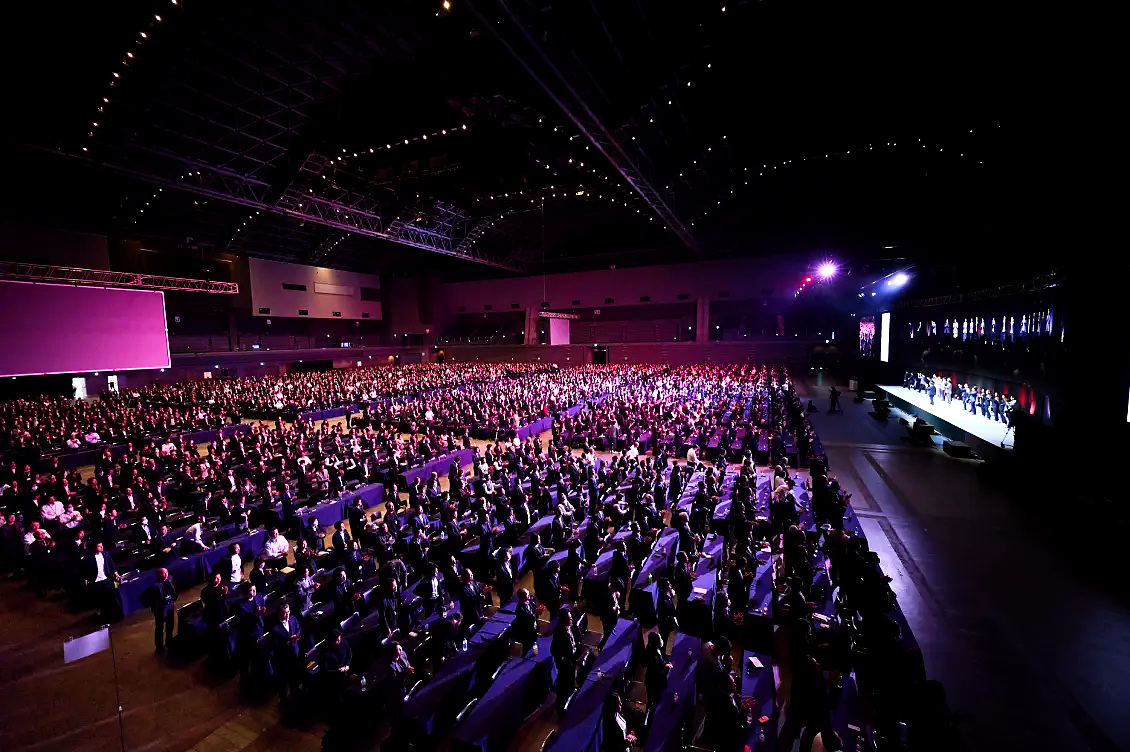
A Sales Kickoff, or SKO, is a company gathering that aligns a sales organization around its targets, go-to-market plan, product priorities, skills and culture for the coming period.
Most modern SKOs combine several functions:
- Leadership alignment: company direction, market outlook and revenue priorities
- Product enablement: launches, positioning, competitive context and demonstrations
- Sales development: workshops, role-play, account planning and regional breakouts
- Recognition: awards and celebration of the previous period’s performance
- Connection: structured networking across regions, functions and leadership levels
- Follow-through: recorded sessions, playbooks and content for ongoing enablement
The destination should support those outcomes. A memorable location can help create attention and conversation, but it cannot compensate for weak content or unclear objectives.
Why Consider Japan for an APAC Sales Kickoff?
Japan is strongest when your team needs a professionally supported business program and a destination experience that can reinforce the event’s strategic message.
1. Mature business-event infrastructure
Japan’s event credentials can be measured. JNTO’s summary of ICCA’s 2025 statistics reported 491 qualifying international meetings in Japan. The country ranked sixth worldwide and first in Asia-Pacific for the fourth consecutive year. The ICCA definition is narrower than corporate SKOs, but the result is a useful indicator of destination capability.
2. Multiple city formats within one country
A Japan program does not have to mean central Tokyo only. A main-stage SKO can be held in Tokyo, Osaka, Kyoto or Yokohama, with a smaller leadership or incentive extension in another destination. The city sequence should be determined by the business agenda and attendee movement—not by a checklist of tourist sites.
3. Cultural material that can support the event story
Japanese craftsmanship, hospitality and performance can give an SKO a distinctive identity. The value comes from interpretation and relevance. A cultural element works best when attendees understand why it is there and how it connects to the year’s theme.
4. A strong base for an incentive extension
Japan can support a clear separation between the core business event and a reward program for a smaller group. See our guide to incentive travel in Japan for program-design considerations beyond the SKO itself.
5. Local production knowledge
Venue rules, supplier practices, loading schedules, interpretation workflows and decision-making can differ from what an overseas team expects. A bilingual production lead should translate more than language: they should translate the operating model and make responsibilities explicit.
| A necessary qualification Japan is not automatically the right answer for every SKO. If most attendees are based in North America, a domestic US venue may be more efficient. If the brief is driven primarily by price, another Asian destination may win. Japan is strongest when its business infrastructure and destination value support a clearly defined objective. |
Japan Is Not Time-Zone Neutral
Japan Standard Time is UTC+9, according to Japan’s National Institute of Information and Communications Technology. That makes Japan convenient for many APAC-based teams, but it should not be presented as a midpoint between the United States and Asia.
For long-haul attendees, the program design matters more than a destination slogan:
- Keep the arrival evening informal.
- Provide at least one night of recovery before substantive sessions for long-haul groups.
- Avoid placing the most important leadership content in the first morning block.
- Use clear arrival windows and separate airport-transfer plans for different regions.
- If remote executives will join, design the live-stream window deliberately rather than extending the in-room day.
Choosing the Right Japanese City
Tokyo is not the universal answer. Choose the city by matching attendee origin, venue format, hotel inventory, cultural design and onward travel.
| City | Best fit | Planning strengths | Watch-outs |
| Tokyo | Most global and APAC SKOs | Broad venue and hotel choice; international access; deep production ecosystem | High-demand dates and complex attendee movement require early planning |
| Osaka | Large programs and Kansai-focused teams | Convention infrastructure; access to Kyoto and the wider Kansai region | Flight and transfer patterns should be checked against attendee origin |
| Kyoto | Leadership programs, cultural extensions and conferences | Distinctive setting; temples, ryokan and conference facilities | Historic venues can have operating restrictions; transport and hotel blocks need careful design |
| Yokohama | Convention-scale programs near Tokyo | Large convention facilities and a compact waterfront district | Some programs may split hotel inventory or airport-transfer plans across the wider Tokyo area |
Kyoto should not be described as a small-group-only destination. The Kyoto International Conference Center lists theater capacities of up to 2,500 in its Event Hall and 1,840 in its Main Hall. The better distinction is program style, venue availability and movement—not a blanket attendee cap.
What a Four-Day Sales Kickoff in Japan Can Look Like
A practical agenda gives long-haul attendees time to arrive, protects the most important content, and keeps cultural programming connected to the SKO narrative.
| Day | Focus | Illustrative content |
| Day 1 | Arrival and welcome | Regional arrivals, hotel check-in, informal welcome reception, no critical presentations |
| Day 2 | Strategy and main stage | CEO address, market outlook, targets, product roadmap, recognition dinner |
| Day 3 | Enablement and collaboration | Regional breakouts, product deep-dives, workshops, account planning |
| Day 4 | Connection and closing | Team experience linked to the annual theme, closing commitments, leadership recap |
| Optional extension | Reward or leadership program | Separate itinerary for top performers, customers or leadership |
This is a planning model, not an industry standard. A two-day regional meeting may need a very different rhythm from a five-day global program.
Two GP Production Examples
The following examples are limited to what GP has publicly documented. They illustrate production choices and scope; they are not presented as proof of universal event outcomes.
Daito Trust Group 53rd Fiscal Year Management Plan Briefing
GLOBAL PRODUCE supported the Daito Trust Group’s 53rd Fiscal Year Management Plan Briefing, a large-scale internal event designed to communicate the group’s management direction and priorities for the new fiscal year.
The event brought together a large number of employees and leaders, making it important to deliver complex management messages in a way that was clear, engaging and easy to follow. GP supported the event through planning, production and on-site execution, helping translate the management agenda into a coherent live experience.
The key lesson from this case is that a management briefing should not be treated as a one-way presentation. When content structure, stage production and audience experience are designed together, a kickoff can become a powerful opportunity to align employees around the company’s direction and build momentum for the year ahead.
MARUHAN North Japan Company 54th Term Budget Achievement Executive Kickoff Conference
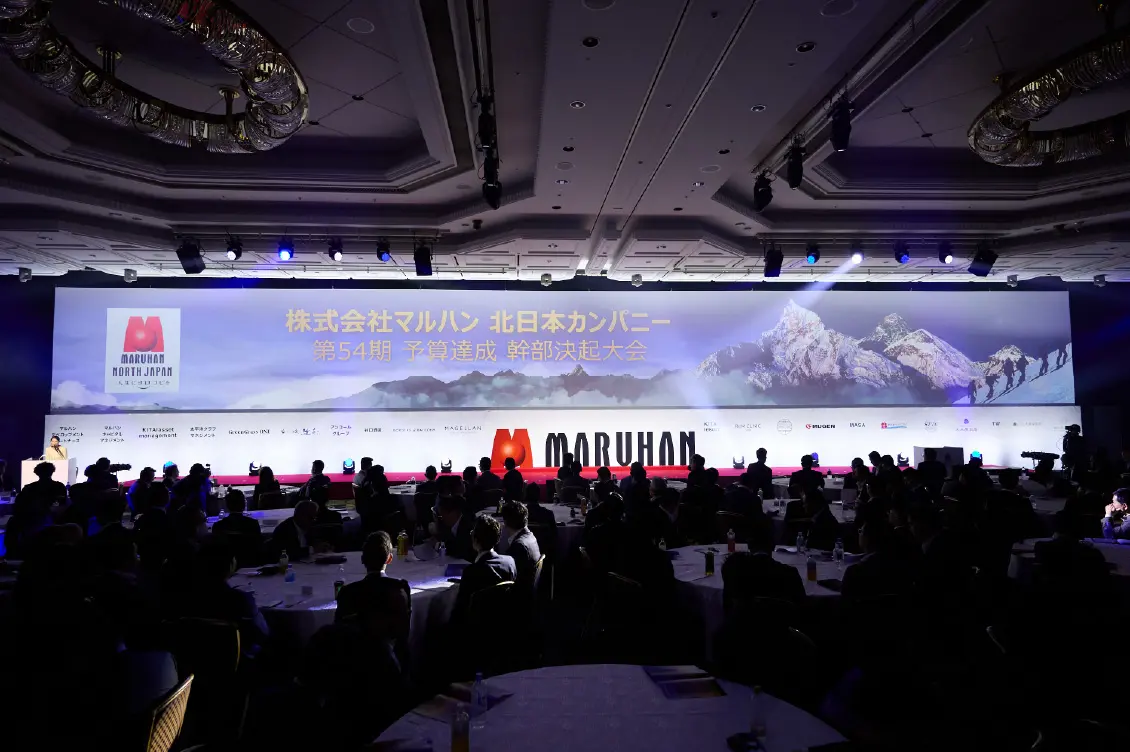
GLOBAL PRODUCE supported MARUHAN North Japan Company’s 54th Term Budget Achievement Executive Kickoff Conference, an important internal event designed to communicate the next term’s policies and goals, review the previous term’s results, recognize business achievements, and unveil the company’s newly developed “Company Ism.”
One of the central production challenges was how to express an appropriate sense of scale while bringing many different pieces of content together into one coherent story. With limited preparation time, GP worked closely with the client to shape the overall experience and maintain a high level of production quality, with employee engagement as an important consideration.
Participant feedback showed that the scale and atmosphere of the event had a strong emotional impact. Employees commented that the experience made them feel proud of the company and helped create a stronger sense of unity around its future direction.
The key lesson from this case is that a kickoff can do more than communicate targets and policies. When the message, story and production scale are designed as one experience, the event can help employees understand where the company is heading and feel more personally connected to that direction.
When to Start Planning
For programs of 200 or more attendees, GP recommends starting 9–12 months ahead. Treat this as a planning benchmark, not a guarantee of availability.
| Timing | Decisions to complete |
| 9–12+ months | Objectives, attendee profile, destination, city, date range, venue shortlist, hotel-block strategy and high-level budget |
| 6–9 months | Program architecture, creative direction, production scope, interpretation needs, offsite design and vendor appointments |
| 3–6 months | Content development, stage and AV design, registration, transport, catering, speakers and cultural programming |
| 8–12 weeks | Detailed run of show, scripts, presentation reviews, rooming data, rehearsals, safety planning and contingency scenarios |
| Final 2 weeks | Content lock, technical checks, final manifests, staff briefing and on-site command structure |
For more detail on venue and staging decisions, see our kickoff planning guide. Start earlier when the date falls in a high-demand period, the venue is non-negotiable, or a large room block is required.
Budgeting a Sales Kickoff in Japan
There is no defensible universal cost per attendee for a Japan SKO. The useful approach is to build the budget by category and document the assumptions behind each line.
- Venue and meeting rooms
- Accommodation and room blocks
- Food and beverage
- Stage, AV, lighting, streaming and technical labor
- Creative, video, presentations and content production
- Registration, event technology and attendee communications
- Interpretation, translation and multilingual signage
- Airport transfers, local transport and offsite movement
- Cultural programming and external experiences
- Insurance, permits, security, medical support and contingency
If you compare Japan with Singapore, Bangkok or another destination, use the same event dates, hotel class, venue standard, production scope, tax treatment, transport assumptions and currency date. Otherwise, the comparison will be misleading.
How to Choose a Japan-Based Event Partner
The best partner is not simply an English-speaking supplier. Look for a team that can own the local operating model while protecting the strategic intent of the SKO.
- Bilingual project leadership. Confirm that the day-to-day lead can manage business context, not only interpretation.
- Relevant corporate-event experience. Ask for kickoff, conference, award and hybrid examples that resemble your program.
- A clear Statement of Work. Venue, production, content, travel, interpretation and approval responsibilities should be explicit.
- Upstream planning capability. A strong partner should challenge venue, agenda and movement decisions before they become expensive.
- One operational command structure. Know who makes decisions during rehearsals and live operation, and how incidents will be escalated.
- Cultural fluency in both directions. The team should explain Japan to global attendees and help global content work appropriately in Japan.
How to Measure SKO ROI
Measure the SKO against business and behavior outcomes defined before the event—not only post-event satisfaction.
- Attendance and completion by region or role
- Understanding of strategic priorities before and after the event
- Adoption of new messaging, tools and enablement content
- Engagement with session recordings and follow-up materials
- Employee connection, confidence or retention indicators
- Relevant commercial indicators such as pipeline movement or quota attainment, interpreted with appropriate caution
Do not attribute every later business result to the event. Use an agreed baseline, combine quantitative and qualitative evidence, and document what the SKO was designed to influence.
Frequently Asked Questions
How far in advance should we start planning a sales kickoff in Japan?
For a program of 200 or more attendees, GP recommends starting 9–12 months ahead. Begin earlier when dates fall in high-demand periods, when the venue is non-negotiable, or when a large hotel room block is required. Smaller leadership programs may be feasible within 6–9 months, subject to availability and scope.
Which Japanese city is best for an SKO?
Tokyo is the most flexible starting point for many international programs. Osaka is useful for Kansai access and large business events. Kyoto works for leadership programs, cultural extensions and large conferences, while Yokohama can support convention-scale programs close to Tokyo. The right city depends on attendee origin, program design and venue requirements.
Is Japan time-zone neutral between the United States and APAC?
No. Japan Standard Time is UTC+9, so Japan is convenient for many APAC teams but should not be described as time-zone neutral for US or European attendees. Build an arrival buffer into the agenda for long-haul travelers.
Do we need Japanese-speaking staff on our side?
Not necessarily. A bilingual Japan-based production lead can manage local venues, suppliers and operating teams while keeping the client-facing project in English. Confirm who owns translation, interpretation and final content approval in the Statement of Work.
Is Japan more expensive than Singapore or Bangkok for a sales kickoff?
There is no reliable universal answer. Compare like-for-like proposals using the same dates, hotel class, venue standard, production scope, transport assumptions, taxes and currency date. Japan may not be the lowest-cost option, so evaluate total program value rather than destination price alone.
Can we combine the SKO with an incentive-travel extension?
Yes. A common design is to hold the core SKO first, then offer a shorter extension for top performers or leadership. Keep the business program and reward component operationally distinct, with clear eligibility, separate budgets and a realistic transfer plan.
How should we measure the ROI of a sales kickoff?
Define the measures before the event. Useful indicators include attendance, session engagement, understanding of strategic priorities, adoption of enablement content, follow-up content usage, employee retention and relevant commercial outcomes. Compare the results with a pre-event baseline where possible.
Final Thought
A Sales Kickoff in Japan works best when Japan is part of the program design, not simply the address on the invitation. The venue, agenda, cultural content, attendee movement and production model should all support the same business objective.
If Japan is one option within a wider Asia shortlist, compare destinations honestly. If Japan wins, involve the local production team before dates, venues and program structure are locked. That is when the most valuable decisions are still available.
To discuss an upcoming program, contact Tomo and the GLOBAL PRODUCE team with your target date, attendee origin, estimated scale and current venue status.

SUPERVISED BY

A collective of event production professionals handling the planning, production, and management of over 200 events annually.
From internal gatherings like shareholders' meetings, anniversaries, and award ceremonies to external PR events and exhibitions, we design and deliver optimal communication solutions. Whether in-person, online, or hybrid, we give form to the messages companies wish to convey.