

How Do New Markets Grow? Event Strategy Through the Lens of Innovation Diffusion Theory
New products and services never spread through the market all at once. There are always people who become excited first.
The people watching a product demonstration with genuine excitement at a launch event.
The people who try something at an experience booth and immediately say, “This is fascinating.”
The people who leave an event eager to share what they experienced with colleagues or on social media.
Markets begin to move from these small sparks of enthusiasm.
At the same time, however, many new products and technologies never grow beyond their initial excitement. They gain traction among early users but fail to reach the more cautious mainstream audience, causing growth to stall. This invisible gap is what marketers commonly refer to as the chasm.
In this article, we’ll explore why events can become the starting point for expanding a market through the lens of Innovation Diffusion Theory and Chasm Theory. Events are far more than opportunities to attract attendees. They are places where people experience something new, share those experiences with others, and ultimately help new value spread throughout the market. We’ll examine this process through established theory as well as findings from our own research.
What Is Innovation Diffusion Theory? Markets Move Through Five Types of Adopters
Innovation Diffusion Theory refers to the Diffusion of Innovations model proposed by American sociologist Everett M. Rogers in 1962. The theory explains how new products, technologies, and ideas are adopted and spread throughout society. Having been validated by more than 6,000 studies over the past six decades, it remains one of the most widely accepted and influential frameworks in the fields of technology adoption and innovation diffusion.
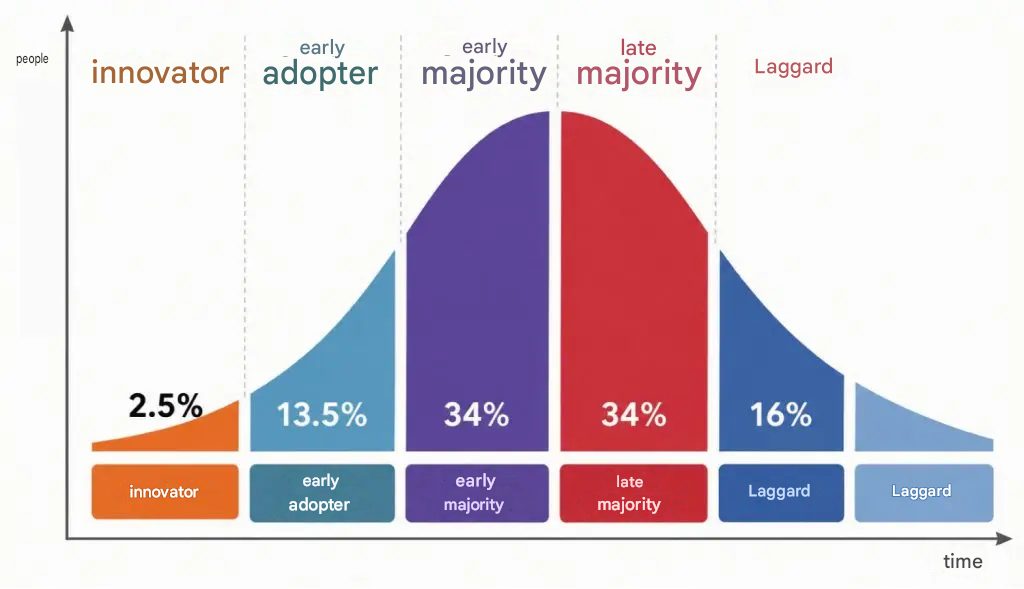
Rogers classified consumers into five categories according to how quickly they adopt new innovations.
The Five Adopter Categories
| Category | Share | Characteristics |
|---|---|---|
| Innovators | 2.5% | The earliest adopters of new ideas and technologies. They enjoy taking risks, value innovation for its own sake, and are generally less sensitive to price. |
| Early Adopters | 13.5% | Opinion leaders deeply embedded in social networks. They recognize new value early and strongly influence those around them, making them critical to market expansion. |
| Early Majority | 34% | A pragmatic group that adopts only after seeing evidence that a product truly works. They tend to move slightly ahead of the average consumer. |
| Late Majority | 34% | Skeptical consumers who adopt only after the majority of the market has already done so. |
| Laggards | 16% | The most conservative and tradition-oriented group, generally uninterested in trends or new technologies. |
When these five groups are plotted over time, they form the well-known S-curve of innovation adoption. Growth begins gradually, accelerates rapidly after reaching a certain point, and eventually slows as the market becomes saturated. Rogers referred to the moment when adoption begins to sustain itself as critical mass.
Opinion Leaders and the Two Product Characteristics That Drive Market Adoption
One of the most important insights from Rogers’ theory is that Early Adopters (13.5%) are opinion leaders. Because they are deeply connected within their social networks, they have a powerful influence on the purchasing decisions of others. In other words, winning over this group largely determines how quickly an innovation spreads throughout the broader market.
Rogers also identified five characteristics of innovations that influence whether people decide to adopt something new. Among them, two are especially relevant to the role of events discussed in this article.
Observability refers to how visible an innovation’s benefits and use cases are to others. When people can see someone else using a product successfully, uncertainty decreases and adoption becomes more likely.
Trialability refers to the opportunity to try a product before purchasing it. Direct, hands-on experience significantly lowers the psychological barrier to adoption.
Chasm Theory: The Largest Gap Lies Between Early Adopters and the Early Majority
Building on Innovation Diffusion Theory, Chasm Theory was introduced by Geoffrey A. Moore in his 1991 book Crossing the Chasm. Moore applied Rogers’ framework specifically to the marketing of high-tech products, creating a model that has since become essential reading for companies seeking to bring disruptive innovations into the mainstream. The book has sold more than one million copies worldwide.
Moore’s key insight was that several gaps exist between the five adopter categories. The most significant of these is the large gap between Early Adopters (13.5%) and the Early Majority (34%)—a gap he called the chasm.
The Deep Divide Between the Early Market and the Mainstream Market
Moore divides the market into two distinct segments: the early market, consisting of Innovators and Early Adopters, and the mainstream market, made up of the Early Majority, Late Majority, and Laggards.
Many new products and technologies perform well in the early market but fail when attempting to cross into the mainstream market. They fall into the chasm before reaching broader adoption, causing growth to stall.
According to Moore, one of the clearest signs that a company has fallen into the chasm is stagnating sales. A product may experience rapid growth immediately after launch as it gains traction among early adopters, but once that initial market becomes saturated, sales plateau. Without successfully reaching the mainstream market, momentum fades and growth comes to a halt—an outcome companies must avoid.
Why the Chasm Exists: Two Groups with Completely Different Buying Motivations
The fundamental reason the chasm exists is that Early Adopters and the Early Majority make purchasing decisions for entirely different reasons.
| Early Adopters (Visionaries) | Early Majority (Pragmatists) |
|---|---|
| Value a product for its innovation and future potential. | Value the supplier’s reputation, proven results, and reliability. |
| Willingly accept risk in exchange for the advantage of being among the first to adopt. | Avoid risk and seek evidence that a product genuinely works before adopting it. |
| Rely on feedback from Innovators and fellow Early Adopters within broad innovation networks. | Trust recommendations and proven results from peers in similar industries and roles. |
The third point is particularly important. The Early Majority does not place significant trust in the opinions of Innovators or Early Adopters. Instead, they rely on recommendations and proven success from their peers—people working in similar industries, organizations, or roles.
For this reason, Moore argues that references and testimonials are the key to crossing the chasm.
Why Events Can Become the Starting Point for Market Expansion
Events have the unique ability to activate the mechanisms described by both Innovation Diffusion Theory and Chasm Theory within a single environment. There are four key reasons why.
Events Maximize Observability and Trialability
Rogers identified Observability and Trialability as two of the most important factors influencing adoption. Events bring both to life in ways that digital marketing simply cannot.
Visitors can experience new products firsthand through demonstrations and hands-on interactions, satisfying Trialability. At the same time, they can observe other attendees using and reacting to those products, increasing Observability.
This combination creates a level of confidence that is difficult to achieve through advertising alone.
Events Bring Together Opinion Leaders
Early Adopters—the opinion leaders identified by Rogers—play a pivotal role in market expansion.
Events provide a rare opportunity to gather these influential individuals in one place and give them a memorable firsthand experience with a product or service. The moment they think, “This is interesting,” or “This really works,” often becomes the starting point for broader market adoption.
Events Generate Testimonials
As Chasm Theory suggests, testimonials are essential for convincing the Early Majority.
Events naturally transform firsthand experiences into references that others can trust. Speaker presentations, participant feedback, social media posts, interviews, and media coverage all become valuable sources of social proof that can later be shared with more cautious audiences.
Events Amplify Reputation and Spark Wider Adoption
Most importantly, an event is not a single point in time—it is the starting point of wider market diffusion.
An event attended by 500 people is never just about those 500 attendees. Its true impact comes from the multiplier effect created by 500 opinion leaders, each with their own professional networks, combined with media coverage, influencer content, and the continued use of event content through a company’s own communication channels.
This expanding network of influence becomes the bridge that carries enthusiasm from the early market into the mainstream market, helping organizations cross the chasm and accelerate adoption.
Five Steps to Expand a Market Through Events
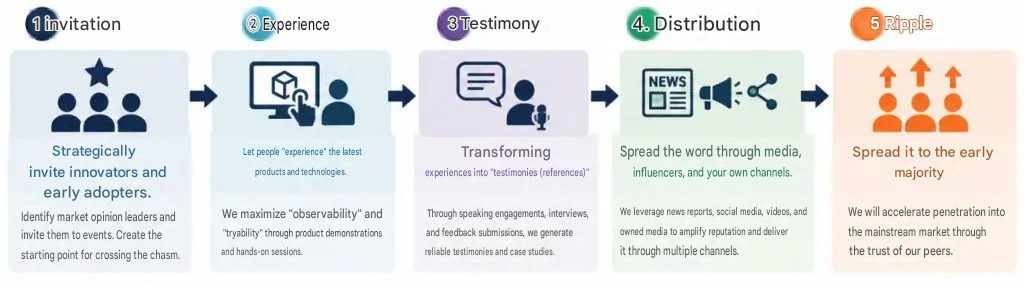
How can an event be designed to drive market expansion? Below is a practical five-step framework that translates theory into actionable strategy.
STEP 1: Strategically Invite Innovators and Early Adopters
The first question to consider is who should attend.
Identify and strategically invite opinion leaders who have influence within your market. In B2B industries, this may include decision-makers from companies known for innovation, influential industry figures, and journalists from trade publications. Their initial impressions and evaluations will shape the quality and reach of the product’s future adoption.
STEP 2: Let People Experience the Latest Products and Technologies
The core of any successful event is experience.
Incorporate opportunities such as product demonstrations, hands-on sessions, early-access experience zones, and realistic use-case simulations so participants can fully appreciate the product through direct interaction.
The goal is not simply to explain specifications, but to create genuine understanding through experience. Maximizing Observability and Trialability is what inspires opinion leaders to embrace and advocate for the product.
STEP 3: Turn Experiences into Testimonials
An experience alone is not enough to drive wider adoption.
It must be transformed into testimonials that can be shared afterward. This can include customer use-case presentations, recorded participant interviews, attendee feedback, social media posts, and photo opportunities designed to encourage sharing.
These become the trusted references that the Early Majority looks for when deciding whether to adopt a new product or service.
STEP 4: Amplify Those Testimonials Across Multiple Channels
Once testimonials have been created through the event, they should be distributed across a variety of communication channels.
Media Channels
- Press releases
- Coverage generated through media invitations
- Exposure in industry publications
Influencer Channels
- Social media posts from participating opinion leaders and influencers
- Blog articles
- YouTube videos and other content sharing firsthand experiences
Owned Channels
- Event recap articles
- On-demand session recordings
- Sales enablement materials
- Webinar content
- White papers
The objective is to place these trusted endorsements into the information environments where the Early Majority actively seeks guidance.
This is particularly important because the Early Majority places the greatest trust in people who share similar roles, industries, and business challenges. The more closely testimonials reflect their own circumstances, the more persuasive they become.
STEP 5: Reach the Early Majority and Cross the Chasm
As testimonials and corporate reputation continue to reach the market through multiple channels, they gradually reduce the uncertainty felt by the cautious Early Majority.
“They’ve already implemented it.”
“A respected industry publication covered it.”
“A company similar to ours recommends it.”
When enough of these trusted signals accumulate, they reach a tipping point. At that stage, the Early Majority begins adopting the product, accelerating its spread throughout the broader market.
This is the mechanism by which an event becomes the starting point for crossing the chasm.
Why Events Help Build Markets: Insights from Our Original Research
The idea that events can accelerate market development is supported not only by theory, but also by real-world data.
Let’s compare these concepts with the findings from an original survey conducted by GLOBAL PRODUCE. The survey targeted 108 marketing professionals at B2B companies that had hosted in-person conferences with budgets of ¥10 million or more.
Building Reputation: 66.7% Improved Brand Awareness, While 47.2% Strengthened Their Position as Market Leaders
One of the key factors valued by the Early Majority is a company’s reputation.
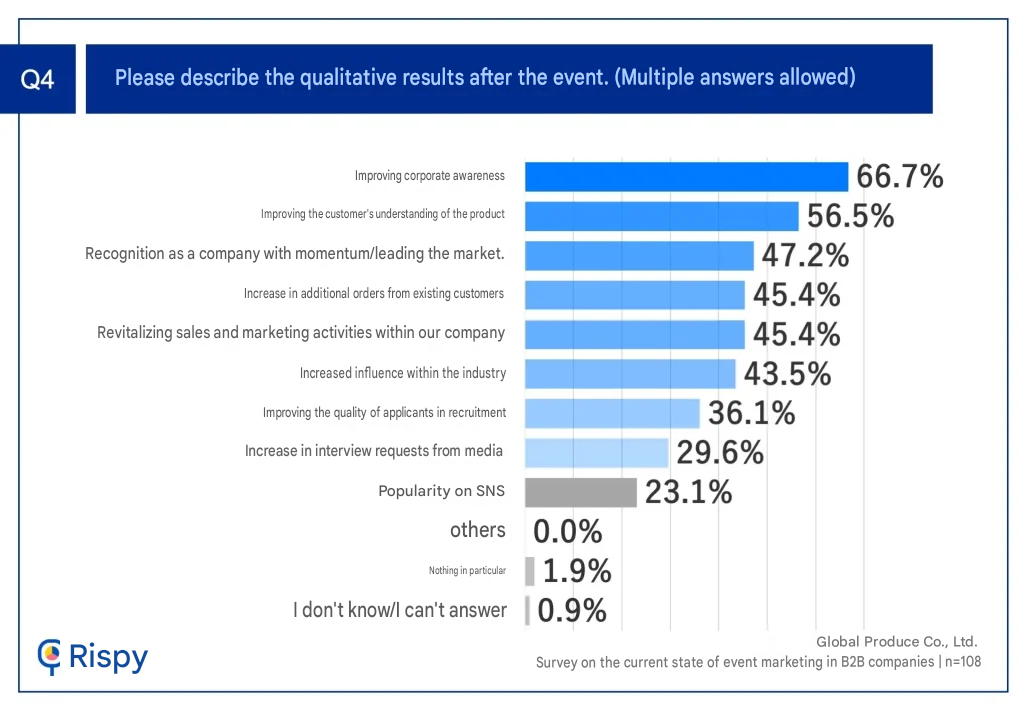
Our survey found that, among the qualitative outcomes achieved after hosting an event:
- 66.7% reported increased brand awareness.
- 47.2% said their company came to be recognized as an innovative or market-leading organization.
These outcomes represent exactly the type of reputation signals that the Early Majority looks for when deciding whether to adopt a new product or service.
In addition, 56.5% reported that potential customers gained a better understanding of their products. This suggests that providing opportunities for Observability and Trialability helped participants better understand the value of the offering, closely aligning with Rogers’ theory.
Business Results That Contribute to Market Expansion: 59.3% Increased New Sales Opportunities, While 57.4% Improved Close Rates
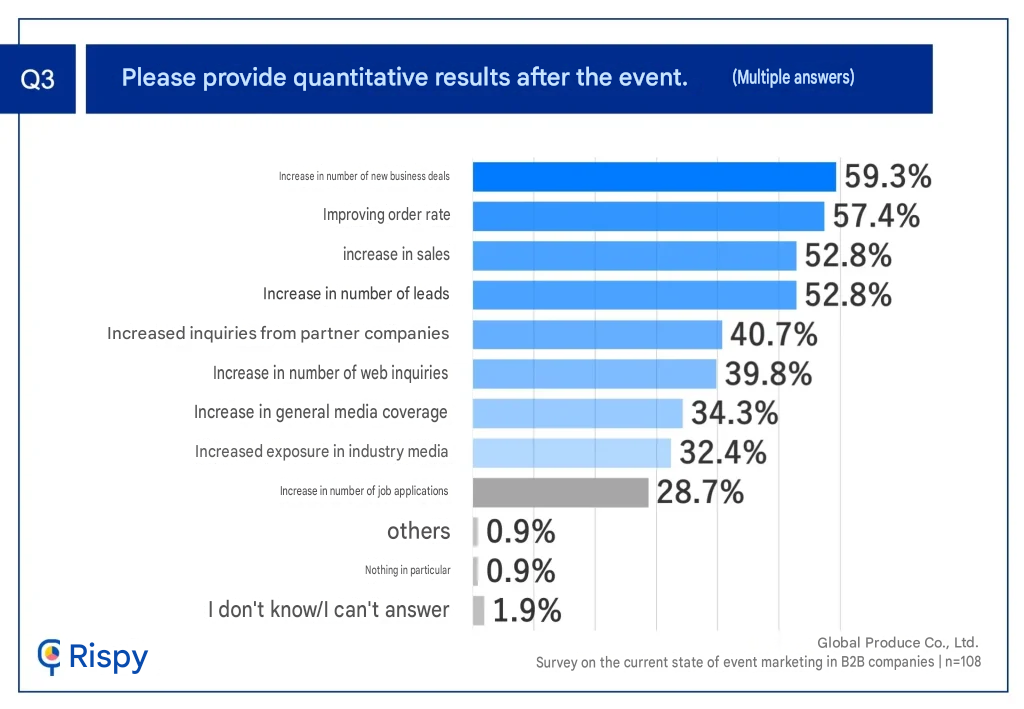
The survey also revealed measurable business outcomes associated with successfully crossing the chasm.
- 59.3% reported an increase in new sales opportunities.
- 57.4% experienced higher proposal or deal conversion rates.
These findings suggest that the awareness and product understanding generated through events can translate into meaningful business results, including new customer acquisition and increased sales performance.
Rather than serving as one-time marketing activities, events have the potential to become the starting point for long-term market development.
Extending Event Impact: 63.9% Reused Event Content as Sales Materials, While 58.3% Repurposed It for Webinars
The distribution strategy described in Step 4 is already being widely adopted by many organizations.
When asked how they repurposed event content after the event, respondents reported the following:
- 63.9% converted event content into sales materials.
- 58.3% reused it for webinars.
- 53.7% distributed session recordings as on-demand content.
- 49.1% provided event content as material for media coverage.
Each of these approaches helps deliver the testimonials generated during the event into the information channels where the Early Majority looks for trusted references.
What Participants Value Most: 59.3% Appreciated Innovative Case Studies
The survey also provides insight into what attendees expect from business events.
Among the most valuable takeaways identified by participants were:
- 59.3% found innovative case studies particularly valuable.
- 52.8% gained ideas for solving challenges within their own organizations.
- 51.9% gained a better understanding of the latest industry and market trends.
These findings suggest that attendees actively seek innovation and real-world examples from their peers. In other words, events naturally function as hubs for generating and distributing the references and success stories that support wider market adoption.
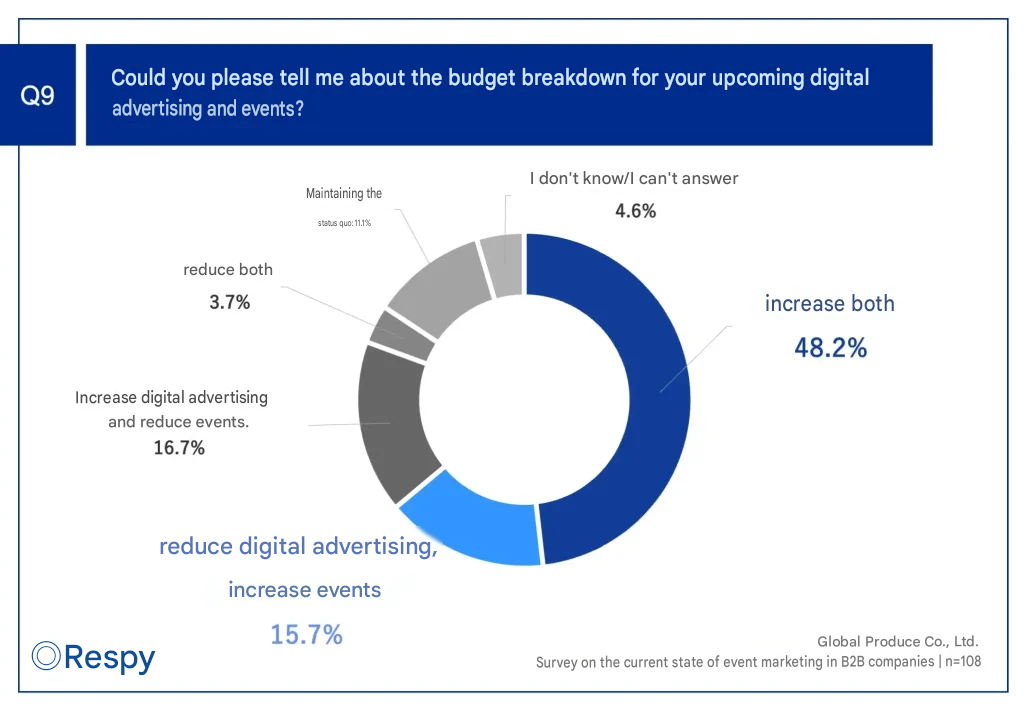
Taken together, the survey findings demonstrate that events can fulfill several essential functions required for market expansion: building reputation, converting awareness into business opportunities, and generating and distributing trusted testimonials throughout the market.
Download the full report: BtoB Event Marketing Survey Report
Key Considerations for Creating Events That Expand Markets
To put these theories and frameworks into practice, it’s important to focus on a few essential principles.
Start by Identifying the Right Audience Based on Your Product’s Adoption Stage
The audience you invite should depend on where your product currently sits in the adoption lifecycle.
If you’re introducing a product to the market, your priority should be to attract Innovators and Early Adopters—the opinion leaders who can generate influential testimonials. If your product has already gained traction in the early market, your focus should shift toward attracting Early Majority customers by presenting practical use cases, proven results, and data that address their concerns and reduce perceived risk.
Invest in the Quality of the Experience
Crossing the chasm begins with creating a powerful firsthand experience for opinion leaders.
Rather than relying on presentations that simply explain product specifications, invest in demonstrations, immersive environments, and interactive experiences that allow attendees to understand the product’s value through all five senses.
Designing an event that maximizes Observability and Trialability should be a central objective.
Plan How You Will Capture Testimonials Before the Event Begins
Don’t wait until the event is over to collect feedback.
Instead, determine during the planning stage what kinds of testimonials you want to gather, in what format, and from whom.
Interview opportunities, permission to reuse presentation materials, and social media engagement strategies should all be incorporated into the event design from the beginning. Careful planning determines both the quality and quantity of the testimonials you’ll be able to leverage afterward.
Prepare Multiple Distribution Channels
Media outreach, influencer engagement, and your own communication channels should all be planned well before the event takes place.
Because the Early Majority places the greatest trust in people who share similar backgrounds and business challenges, it’s particularly effective to highlight testimonials from organizations and professionals they can easily relate to.
Ideally, a single event should generate enough material to be repurposed into five to ten different pieces of content, maximizing its long-term impact.
Measure Events as Investments in Market Creation, Not One-Time Campaigns
If you evaluate an event solely by the number of attendees or leads generated immediately afterward, you’ll overlook much of its true value.
Its real impact lies in the reputation it builds, the testimonials it generates, and the sustained market influence created through secondary content and ongoing distribution.
Only by considering these long-term effects can you fully understand the strategic value of an event.
Conclusion: Events Are the Starting Point for Market Expansion
In this article, we’ve explored why events can serve as the starting point for market expansion through the established frameworks of Innovation Diffusion Theory and Chasm Theory.
To summarize:
- Innovation Diffusion Theory: Markets evolve through five adopter groups—Innovators (2.5%), Early Adopters (13.5%), Early Majority (34%), Late Majority (34%), and Laggards (16%). The keys to adoption are Observability, Trialability, and the influence of Opinion Leaders.
- Chasm Theory: The greatest barrier to adoption lies between the Early Adopters and the Early Majority. Crossing the chasm depends on building trusted testimonials and a strong corporate reputation.
- The Role of Events: Events bring together all the essential elements needed to cross the chasm in one place by providing opportunities for observation and hands-on experience, gathering opinion leaders, generating testimonials, and amplifying reputation.
- The Framework: ① Strategic Invitations → ② Product Experience → ③ Testimonial Creation → ④ Multi-Channel Distribution → ⑤ Reaching the Early Majority.
- Research Findings: Our survey supports this framework, with 66.7% reporting increased brand awareness, 47.2% gaining recognition as market leaders, 59.3% generating more new business opportunities, and 63.9% repurposing event content as sales materials—demonstrating the potential of events to drive market creation.
Events are far more than opportunities to attract attendees or promote products.
They are strategic investments that help carry new products and technologies from enthusiastic early adopters into the mainstream market—bridging the chasm and accelerating widespread adoption.
As customer acquisition costs through digital advertising continue to rise, the strategic value of events that create memorable experiences, build reputation, and generate trusted advocacy has never been greater.
At GLOBAL PRODUCE, we leverage our experience of producing more than 200 business events each year to provide comprehensive support—from event planning and production to operations and post-event marketing initiatives.
Whether you’re launching a new product or service, strengthening your position within your industry, or developing an event strategy designed to cross the chasm, we’d be delighted to help. Please feel free to get in touch.

SUPERVISED BY

A collective of event production professionals handling the planning, production, and management of over 200 events annually.
From internal gatherings like shareholders' meetings, anniversaries, and award ceremonies to external PR events and exhibitions, we design and deliver optimal communication solutions. Whether in-person, online, or hybrid, we give form to the messages companies wish to convey.